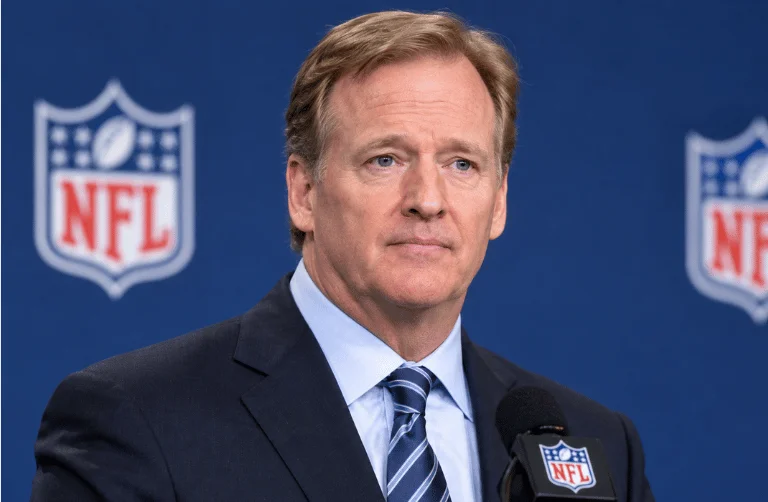
Roger Goodell has led the National Football League since 2006 and remains one of American sports’ most influential executives. His story starts far from a boardroom, with an entry-level league internship secured after repeated letters. In 2026, a new contract extension guarantees that his tenure will continue through the 2030 NFL season.
| Key fact | Current information |
|---|---|
| Age in 2026 | 67 |
| Born | February 19, 1959, in Jamestown, New York |
| Current role | NFL commissioner |
| Commissioner since | September 1, 2006 |
| NFL career began | 1982 |
| Education | Washington & Jefferson College, economics degree, 1981 |
| Family | Wife Jane Skinner and twin daughters |
| Current contract | Through the 2030 league season, ending March 31, 2031 |
| Recent publicly reported pay | $63.9 million annually for the 2019-20 and 2020-21 league years |
| Current salary | Not publicly disclosed |
| Net worth | Not publicly verified; third-party estimates vary |
Roger Goodell is the NFL commissioner, a role he has held since September 1, 2006. He is 67 in 2026 and is under contract through the 2030 league season, ending March 31, 2031. His career began with a league-office internship in 1982 after a persistent letter-writing campaign.
Key Takeaways
- Goodell became commissioner in 2006 after working inside the league since 1982.
- His September 2026 extension runs through the 2030 season and expires March 31, 2031.
- More than 95% of his new compensation is tied to performance, according to the league.
- The NFL does not currently publish his salary, so recent fixed figures are estimates.
- His tenure combines major business growth with recurring debate over discipline and player safety.
Who Is Roger Goodell, and What Does the NFL Commissioner Do?
Goodell is the chief executive of the NFL and works on behalf of the league’s 32 clubs. The job covers football operations, business strategy, labor relations, league discipline, media partnerships, and international growth. His authority also places him at the center of disputes involving rules, conduct, and competitive integrity.
The role is unusual because team owners employ the commissioner while players bargain through their union. That structure requires the office to balance club interests, league policy, and negotiated labor rules. It also makes the commissioner a visible target whenever fans dislike a major league decision.
Early Life, Education, and the Internship That Started His Career
Goodell was born in Jamestown, New York, on February 19, 1959. He later attended Bronxville High School and competed in football, basketball, and baseball. A knee injury ended his plans to play college football before his first season.
He attended Washington & Jefferson College and graduated in 1981 with an economics degree. The future commissioner then wrote repeatedly to the NFL and its teams seeking work. An official league biography says the campaign totaled 40 letters before he secured a 1982 internship.
He spent 1983 with the New York Jets before returning to the league office in 1984. Over time, he moved through public relations, football operations, league business, and executive leadership. That long internal career gave him experience across the commercial and competitive sides of professional football.
Readers interested in NFL career paths can compare his executive route with Newpapero’s Eddie Murphy Net Worth. Keisel followed the player path and spent 12 seasons with the Pittsburgh Steelers. The newspaper’s Entertainment section also collects more profiles and coverage from across athletics.
How He Became Commissioner in 2006
League owners selected Goodell in August 2006 to succeed Paul Tagliabue. He formally took office on September 1, 2006, after more than two decades inside the NFL. His promotion made him responsible for a league already growing rapidly in media value and national reach.
His early priorities included personal conduct, stadium development, officiating, revenue sharing, and international expansion. Player health and safety also became a central subject during his tenure. Those responsibilities expanded as the NFL added digital media deals and more international regular-season games.
The 2026 Contract Extension and Why It Matters

In September 2026, owners approved a four-season extension through the 2030 league season. The agreement runs until March 31, 2031, matching the current collective bargaining agreement’s expiration month. It is his fifth extension since he became commissioner.
The contract is heavily incentive-based rather than a simple fixed salary arrangement. The NFL said more than 95% of total compensation depends on performance measures and committee discretion. Financial terms were not publicly released, so precise current-pay claims should be treated cautiously.
The timing gives owners leadership continuity before major labor and media decisions. Future talks could include a possible 18-game regular season and new broadcast agreements. Those issues may shape the league’s economics and player workload during the rest of his contract.
Salary and Net Worth: What Is Verified and What Is Estimated?
The NFL does not publicly disclose the commissioner’s current annual compensation. Reuters reported that he received $63.9 million in each of two earlier league years. Those figures covered the 2019-20 and 2020-21 seasons and included substantial incentive compensation.
Current salary figures published by entertainment and wealth websites are not confirmed contract disclosures. The same caution applies to net-worth estimates, because his assets and liabilities are private. Recent third-party estimates commonly fall around $250 million to $300 million, but neither figure is audited.
| Money question | Best-supported answer | How to read it |
|---|---|---|
| Current salary | Not publicly disclosed | A fixed 2026 figure cannot be confirmed. |
| Recent reported annual pay | $63.9 million | Reported for 2019-20 and 2020-21 |
| New contract structure | More than 95% performance-based | Confirmed by the NFL in 2026 |
| Net worth | Private | Published estimates are not audited. |
This distinction matters because salary, bonuses, career earnings, and net worth measure different things. Gross compensation does not equal wealth after taxes, spending, investments, or other obligations. The newspaper uses the same profile format in its Ja Morant career and net-worth article.
Wife, Children, and Family Life
Goodell is married to Jane Skinner, a former television journalist who worked at Fox News. The couple married in 1997 and have twin daughters, born in 2001. Their daughters have generally remained outside the public spotlight.
Skinner left her regular television role in 2010 and later worked on media projects. Goodell’s public appearances usually focus on league business rather than his family. That separation explains why reliable details about his private life remain relatively limited.
Major Decisions, Growth, and Controversies
His tenure has coincided with major growth in NFL media reach, international scheduling, and franchise values. The league has also emphasized rule changes and equipment work aimed at reducing injury risks. Supporters of his tenure often point to business growth and the league’s global expansion.
Criticism has focused on discipline, player safety, and the commissioner’s broad authority in league investigations. High-profile disputes included Bountygate, Deflategate, conduct cases, and continuing debate about concussion policy. Different groups have disputed individual decisions, even while owners repeatedly renewed his contract.
The mixed record helps explain why public views of the commissioner can be sharply divided. Owners judge the role partly through league performance, revenue, stability, and negotiated agreements. Fans and players may focus more on discipline, officiating, safety, and the effects of schedule changes.
What Comes Next Through 2030?
The next four seasons could be unusually important for the commissioner’s long-term record. Labor negotiations, broadcast contracts, international growth, and schedule structure all remain major subjects. An 18-game season would require bargaining with the NFL Players Association rather than unilateral league action.
His contract now extends to the same 2031 endpoint as the current labor agreement. That alignment gives the league one executive leader through the next negotiating cycle. It also means retirement speculation has shifted beyond the timeline that existed before September 2026.
Frequently Asked Questions
How old is Roger Goodell?
He is 67 years old in 2026. He was born on February 19, 1959, in Jamestown, New York.
Who is Goodell’s wife?
His wife is Jane Skinner, a former Fox News journalist. They married in 1997 and have twin daughters. Skinner left regular television news work in 2010.
How long has Goodell been NFL commissioner?
He has served as commissioner since September 1, 2006. That means his tenure will reach 20 years in September 2026. He worked for the league for 24 years before taking the top job.
How much does Goodell make?
His current compensation is not publicly disclosed by the NFL. Reuters reported $63.9 million annually for the 2019-20 and 2020-21 league years. The 2026 extension ties more than 95% of compensation to performance measures.
Did Goodell ever play football?
He played football in high school and was a multi-sport athlete. He planned to play college football at Washington & Jefferson. A knee injury before his freshman season ended those plans.
When does his current NFL contract end?
The current extension covers the 2030 league season. It is scheduled to end on March 31, 2031. That date also matches the current collective bargaining agreement’s expiration month.
Why His Story Still Matters
Goodell’s career shows how league leadership can shape both sports business and the game fans watch. His rise from intern to commissioner remains unusual among major American sports executives. His new extension ensures that his influence will continue through several important NFL decisions.
Readers can follow more football biographies through the newspaper’s sports coverage. The site also features profiles of players whose careers show another side of professional athletics. Those stories help place front-office decisions beside the experiences of people on the field.