A simple jurisdiction definition is the legal power a court, tribunal, or public authority has to decide matters within set limits. In a court case, those limits can depend on the type of dispute, the parties or property involved, and the geographic connection. They can also depend on whether a court hears a case first or reviews an earlier decision.
Key Facts at a Glance
| Concept | Plain-English meaning | Question it answers |
|---|---|---|
| Jurisdiction | Legal authority to hear and decide a matter | Can this court decide the dispute? |
| Subject-matter authority | Power over a category of cases | Can this court hear this kind of case? |
| Personal authority | Power over a party in the case | Can the court bind this person or business? |
| Territorial authority | Geographic reach of court power | Does this dispute have the required connection to this place? |
| Venue | Proper geographic place for the proceeding | Which court location should hear the case? |
Jurisdiction Definition: What the Term Means in Law
The word jurisdiction is closely connected to legal power. Cornell Law School’s Legal Information Institute explains that it can mean a court’s power to decide cases and issue orders. It can also describe the territory within which a court or government body may exercise its authority.
That distinction matters because a court does not gain unlimited authority simply because someone files a lawsuit there. The governing constitution, statutes, procedural rules, and other laws determine what the court may decide.
For readers learning legal concepts, NewPapero’s Law section provides a useful place to explore related topics.
Main Types of Court Jurisdiction
Legal systems do not always organize court authority using identical labels. Still, three ideas commonly help explain why a particular court can or cannot decide a dispute.
Subject-Matter Jurisdiction
Subject-matter authority concerns the type of dispute a court may hear. A court created to handle a limited category of cases cannot automatically decide every legal controversy.
In the United States, federal courts have limited authority defined by the Constitution and federal statutes. State courts generally have broader authority, although state law and federal rules can still limit the matters they may hear.
For example, the first question in a bankruptcy, family-law, probate, or federal constitutional case may be whether that court can hear that category of dispute at all.
Personal Jurisdiction
Personal jurisdiction asks whether a court has legal power over a particular defendant or other party.
In U.S. law, the inquiry can depend on the defendant’s relationship with the forum. Modern constitutional doctrine considers whether that relationship is sufficient for the court to exercise power in a manner consistent with due process.
This issue can arise when a person lives in one state but is sued in another. Similar questions arise when a company operates across several locations.
Territorial Jurisdiction
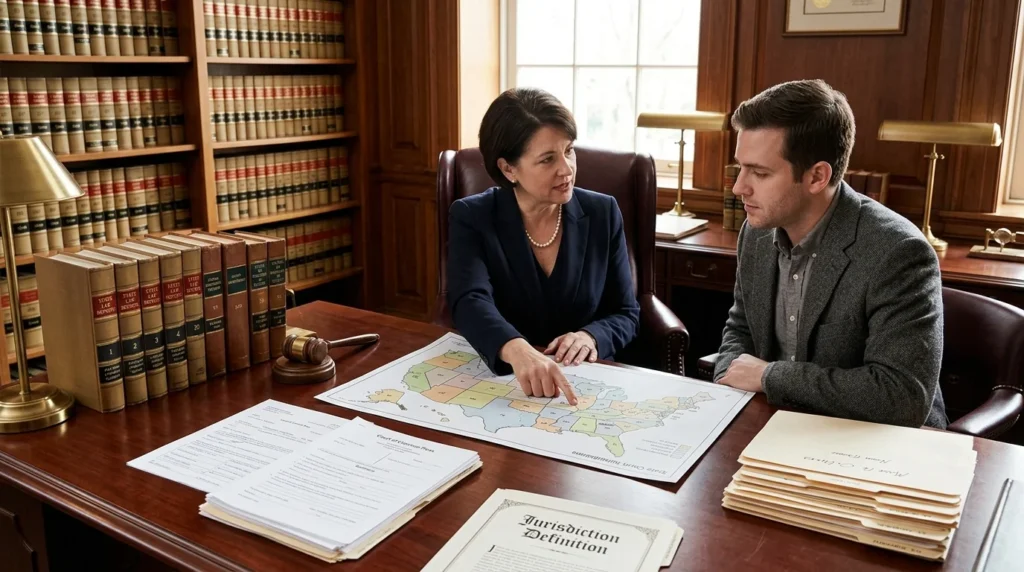
Territorial authority focuses on geographic reach. It considers where a court is permitted to exercise its legal power.
Possible connections may include where events occurred, where the parties live, or where relevant property is located. The exact rules depend on the governing legal system and the type of case.
A property dispute is a practical example of why location can matter. NewPapero’s guide to a co-owner refusing to sell shared property shows how a property disagreement may eventually require court involvement.
Other Ways Courts Describe Their Authority
Court power can also be classified according to the court’s role or its relationship with other courts.
Common descriptions include:
- Original authority: The court hears the matter at its first judicial stage.
- Appellate authority: A higher court reviews a lower court’s decision.
- Exclusive authority: Only a specified court or court system may hear a particular type of matter.
- Concurrent jurisdiction: Two courts may have legal power to hear the same type of case.
- In rem authority: The court’s power centers on property or another legal status rather than solely on a person.
For example, the U.S. Supreme Court has original authority over certain categories of cases and appellate authority over many federal-law matters. These labels describe different aspects of court power. They should not be treated as competing definitions of the same concept.
A Four-Question Court-Power Check
When you are trying to understand why a case belongs in a particular court, four questions can make the issue easier to organize:
- What kind of case is it? Identify whether the dispute involves criminal law, contracts, family law, federal law, property, bankruptcy, or another subject.
- Who or what must the court bind? Consider the defendants, organizations, property, or legal interests affected by the decision.
- What place connects the case to the court? Look at where people live, where events occurred, where business took place, or where property is located.
- What stage has the case reached? Determine whether the court will hear it first or review a decision made below.
This checklist does not determine the legal answer on its own. It gives you a practical way to identify which authority questions may need closer research.
Jurisdiction vs. Venue: What Is the Difference?
These terms are related, but they answer different questions.
| Issue | Court authority | Venue |
| Main question | Does the court have legal power to decide? | Is this the proper geographic place to hear the matter? |
| Main focus | Power over the case, parties, or territory | Location of the proceeding |
| Example | Whether a federal court may hear a certain claim | Which federal judicial district is the proper location |
| Effect of a problem | May prevent the court from deciding the matter | May require a different location, depending on the rules |
The U.S. Courts glossary defines court authority as the legal power to hear and decide a certain type of case. Cornell describes venue as the proper geographic location and court for a civil or criminal proceeding.
A court can therefore have legal jurisdiction over a dispute, even when a different location is the proper venue. The rules governing either issue depend on the court system involved.
What Happens If a Court Lacks Legal Authority?
A court must have the required legal power before it can properly decide a matter. The consequences of a defect depend on the type of authority involved and the applicable procedural rules.
For example, Cornell notes that a lack of subject-matter authority can affect the validity of a judgment in U.S. law. An official federal district court glossary also explains that a case may be dismissed or transferred when the court lacks the required power.
That is why parties may raise court-power questions early in litigation. The precise procedure should always be checked under the rules governing the specific case.
The Practical Takeaway
Court authority answers a basic question: Does this decision-maker have legal power over this matter? To answer it, look at the subject of the case, the parties or property involved, the geographic connection, and the court’s role.
If you are studying the concept, reviewing a filing, or trying to understand a legal dispute, identify those four points before moving to procedural details. You can also browse NewPapero’s broader Education resources for more explanatory content.
What happens when a court lacks jurisdiction?
The court may be unable to decide the matter properly. Depending on the legal system and the nature of the defect, the case may be dismissed, transferred, or challenged on the resulting judgment. Because the consequences can be serious, anyone dealing with an active case should check the governing court rules or seek qualified legal advice.
Frequently Asked Questions
A simple definition of jurisdiction is the legal authority granted to a court or public body to make decisions within certain limits. Those limits may concern the type of matter, the parties, the property involved, or the relevant geographic area.
A useful introductory breakdown includes subject-matter, personal, and territorial authority. The first concerns the type of case. The second concerns power over a party, while the third focuses on geographic reach. Other classifications can also matter, including original, appellate, exclusive, concurrent, and property-based authority.
No. Court authority asks whether a court has legal power to hear the matter. Venue normally asks whether a particular geographic location is the proper place for the proceeding. The two issues can overlap in practical litigation, but they are not interchangeable.
Yes, in some circumstances. Cornell describes concurrent authority as a situation in which two courts can share power to hear cases of the same type arising in the same place. Which court should hear the case can then depend on additional statutes, procedural rules, filing choices, and case-specific facts.