


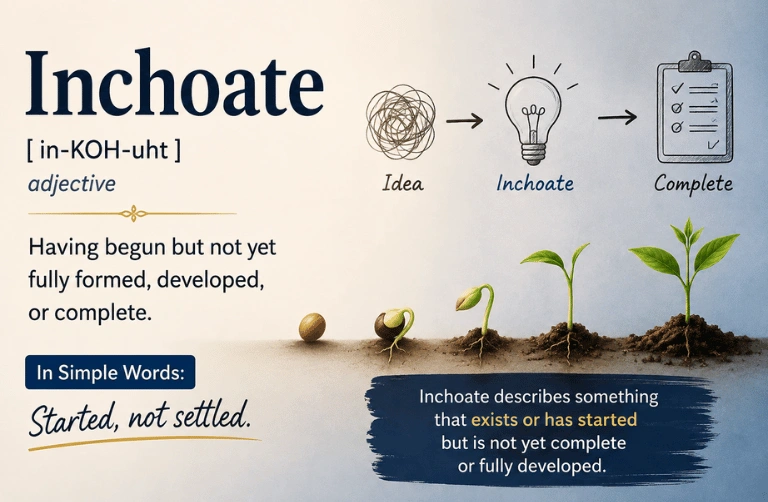
Short answer: “Inchoate” is a formal adjective that describes something that has started but is not fully formed, developed, organized, or complete. You can use it for an idea, plan, feeling, right, or legal matter that exists in an early or unfinished state. Inchoate: The word often suggests that further development or clarification is still needed.
| Key point | What to know |
| Part of speech | Adjective |
| Plain-English sense | Begun but not fully developed or complete |
| Common pronunciation | Roughly “in-KOH-uht,” with another recognized variant |
| Register | Formal; common in academic, literary, and legal writing |
| Common contexts | Ideas, plans, feelings, rights, contracts, and criminal law |
| Origin | From Latin words associated with beginning or starting work |
Major dictionaries share the same central meaning: something exists or has begun but has not yet reached a complete or settled form.
What Does Inchoate Mean?

A useful test is simple: Has something begun without reaching a settled form? If so, this adjective may fit.
The word describes something that is only partly formed, developed, or clear. It can also refer to something that exists in an incomplete state. The term works especially well with abstract things, including ideas, emotions, plans, suspicions, movements, and proposals.
For example:
“The committee had only an inchoate plan for restructuring the program.” That sentence does more than suggest that the plan was poor. It means the plan had begun to take shape but still lacked a complete structure.
A useful distinction exists between unfinished and unclear. Something may be unclear because it is poorly expressed. Inchoate often adds the idea that the thing itself is still developing.
How Do You Pronounce It?
The spelling can mislead readers because the “ch” does not sound like the beginning of “chair.” A common pronunciation can be approximated as in-KOH-uht. Another recognized variant is closer to IN-kuh-wayt. In both cases, the “ch” begins with a hard k sound. If you only need a practical memory aid, think:
in-KOH-uht
Pronunciation can vary slightly by dictionary and dialect. Hearing the word spoken can help before you use it in a speech, presentation, or formal discussion.
How to Use the Word Naturally

This adjective fits formal writing more naturally than casual conversation.
It works well in situations involving:
an idea that exists but lacks detail;
an emotion that is beginning to emerge;
a policy proposal without a finished structure;
a movement that has only started to organize;
a legal interest that has not yet matured.
In everyday conversation, “half-formed,” “undeveloped,” or “still taking shape” may sound more natural.
Context matters more than sophistication. A precise, simple word is better than a formal term used only to sound impressive.
Readers who enjoy language and word-origin articles can also explore Newpapero’s meaning-and-origins explainer about “Tralalero Tralala.”
Synonyms and the Differences Between Them
Several words overlap with this idea, but they are not interchangeable in every sentence. Common alternatives include nascent, incipient, embryonic, rudimentary, and unformed.
| Word | Useful shade of meaning | Good context |
| Incipient | Beginning to happen or appear | an incipient trend |
| Nascent | Newly emerging or coming into existence | a nascent industry |
| Embryonic | At a particularly early stage of development | an embryonic proposal |
| Rudimentary | Basic and lacking refinement | rudimentary skills |
| Unformed | Lacking a settled shape or structure | an unformed opinion |
A quick rule can help. Use “incipient” when something is beginning. Use rudimentary when something is basic. Use unformed when its shape or structure has not yet settled. The target word combines several of these ideas. It often implies both existence and incompleteness.
What the Term Means in Law
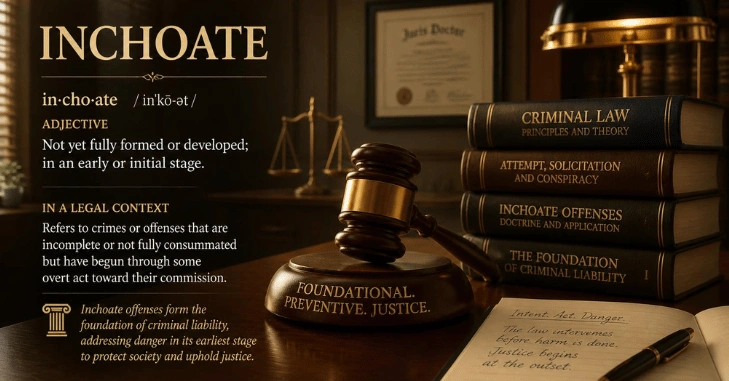
In legal writing, the adjective can have a more specific meaning. It may describe something that is only partially complete, such as a potential crime whose required elements have not all been met. It can also refer to a right or interest that has begun to exist but has not yet matured into a complete legal right.
Criminal law uses another important phrase: inchoate offense. An inchoate offense generally involves conduct directed toward another crime before that target crime is completed. Common categories include attempt, solicitation, and conspiracy.
That does not mean every unfinished criminal plan creates legal liability. Criminal statutes, required intent, and the conduct needed to establish an offense vary by jurisdiction. Anyone facing a criminal charge should seek advice from a qualified lawyer.
Newpaper has a dedicated law section for legal explainers. Its guide on what happens when one co-owner refuses to sell shared property also shows how legal terminology connects with practical disputes.
Where the Word Comes From

The word’s history reinforces its modern meaning. It entered English through Latin terms associated with beginning, starting, or leaving something unfinished. Its historical roots help explain why the word still carries the idea of something that has started but has not yet reached a complete form. That gives you an easy memory device:
Conclusion
Understanding inchoate becomes much easier when you remember its core idea: “started, but not yet settled.” The word describes something that has begun to exist or develop but has not reached a complete, mature, or organized form. It can apply to ideas, plans, emotions, proposals, rights, and other situations where development is still underway.
Although inchoate is more common in formal, academic, and legal writing, it can be useful whenever you need to describe something that is still taking shape. In legal contexts, the term has additional importance because it can describe certain incomplete rights, interests, or offenses, including attempt, solicitation, and conspiracy.
Frequently Asked Questions
It generally describes a right, interest, agreement, or criminal act that has begun but has not reached a completed or fully matured state. In criminal law, related offenses can be punished for certain actions taken in connection with the commission of another crime.
Yes. It is mainly used in formal, academic, literary, political, or legal contexts.
“Half-formed” or “undeveloped” will often work in ordinary speech. Incipient and nascent are useful formal alternatives when you want to emphasize that something is beginning to emerge.
Yes. It can describe feelings, suspicions, or other mental states that are present but not yet fully developed or articulated.
“No. Incoherent” usually refers to something that lacks logical connection or clarity. “Inchoate” primarily describes something that has not yet become fully formed. The ideas can overlap, but they are not identical.