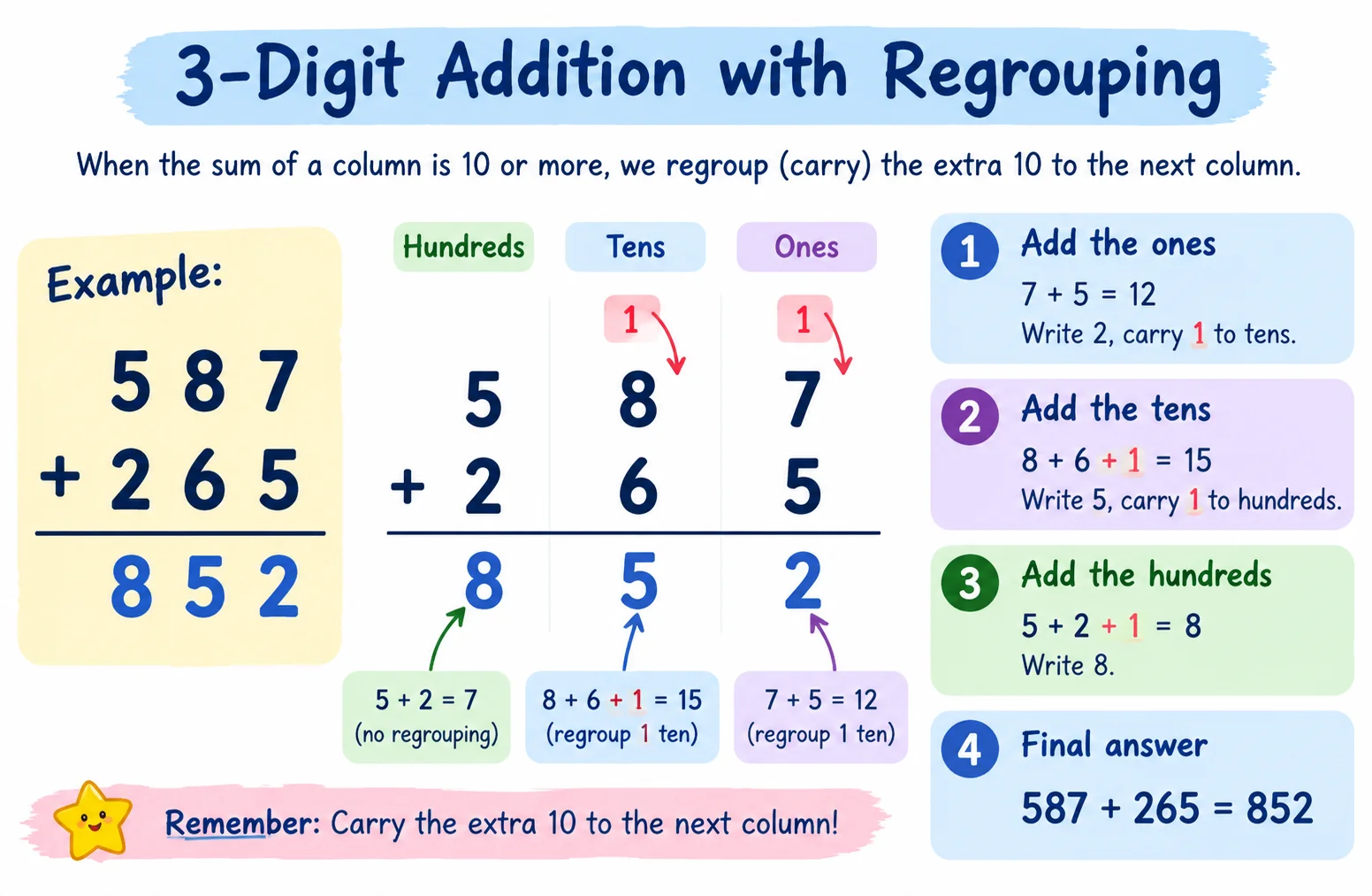
Learning 3 digit addition with regrouping becomes easier when each digit stays in its correct place-value column. Students add the ones first, then the tens, and finally the hundreds. Whenever a column totals ten or more, part of that value moves to the next column.
To add three-digit numbers with regrouping, line up hundreds, tens, and ones. Start with ones, write the ones digit, and regroup any extra ten left. Repeat in tens, then add hundreds and any carried value. Check the result with an estimate before finishing.
Quick Guide to Three-Digit Addition
| Skill | What to Remember |
|---|---|
| Number setup | Line up hundreds, tens, and ones. |
| Starting point | Begin with the ones column. |
| When to regroup | Regroup when a column totals 10 or more. |
| Regrouping ones | Trade 10 ones for 1 ten. |
| Regrouping tens | Trade 10 tens for 1 hundred. |
| Final check | Estimate the sum and compare. |
| Typical grade level | Often taught during grades 2–3 |
Students in the United States often meet this skill while developing place-value understanding and addition fluency. These lessons build a foundation for larger calculations and later math work. Students and families can also browse NewPapero’s education articles for additional learning-focused content.
What Does Regrouping Mean in Addition?
Regrouping means exchanging ten units of one place value for one unit of the next place. Ten ones can become one ten, while ten tens can become one hundred. The total value stays exactly the same during this exchange.
Imagine having 13 individual cubes in the ones column. Ten cubes can be bundled into one group of ten, leaving three individual cubes. That new group belongs in the tens column because its value is ten.
This idea explains why a small carried digit appears above the next column. That digit represents a real place value, not an extra number added without reason. Understanding this connection makes the written method easier to remember.
What Students Need Before Starting
Students should first recognize hundreds, tens, and ones in a three-digit number. They should also know basic addition facts with reasonable confidence. These skills reduce the amount of thinking needed during each problem.
Useful learning tools can make the regrouping process easier to see. A place-value chart separates each column and prevents alignment mistakes. Base-ten blocks or simple drawings can also show why ten units move left.
Helpful materials include
- Pencil and paper
- A hundreds-tens-ones chart
- Base-ten blocks when available
- Addition fact practice
- A short set of carefully chosen problems
How to Do 3 Digit Addition With Regrouping
Use the same order every time you solve a problem. A consistent routine helps students remember carried values and keep columns organized. The following five steps work for most standard three-digit addition problems.
1. Write the numbers vertically. Put ones under ones, tens under tens, and hundreds under hundreds.
2. Add the ones. If the total reaches 10, write the ones digit and regroup one ten.
3. Add the tens. Include any ten regrouped from the ones column.
4. Add the hundreds. Include any hundred regrouped from the tens column.
5. Check the sum. Estimate by rounding the addends and compare the estimated result.
Students should move from right to left when using the standard written method. Starting with the ones allows each regrouped value to enter the next unfinished column. Starting from the hundreds can make later regrouping confusing.
Worked Example: 367 + 185
Consider the problem 367 + 185. First, place 185 directly below 367 so matching place values line up. Then begin with the ones column on the right.
Add 7 + 5 to get 12. Write 2 in the ones place and regroup one ten into the tens column. The regrouped 1 represents ten, rather than one individual unit.
Next, add 6 + 8 + 1 to get 15 tens. Write 5 in the tens place and regroup one hundred to the hundreds column. Finally, add 3 + 1 + 1 to get 5 hundreds.
The completed sum is 552. A quick estimate gives 370 + 190, which is about 560. Since 552 is close to 560, the answer appears reasonable.
| Place | Calculation | Write | Regroup |
|---|---|---|---|
| Ones | 7 + 5 = 12 | 2 | 1 ten |
| Tens | 6 + 8 + 1 = 15 | 5 | 1 hundred |
| Hundreds | 3 + 1 + 1 = 5 | 5 | None |
Why Students Sometimes Forget the Carried Number
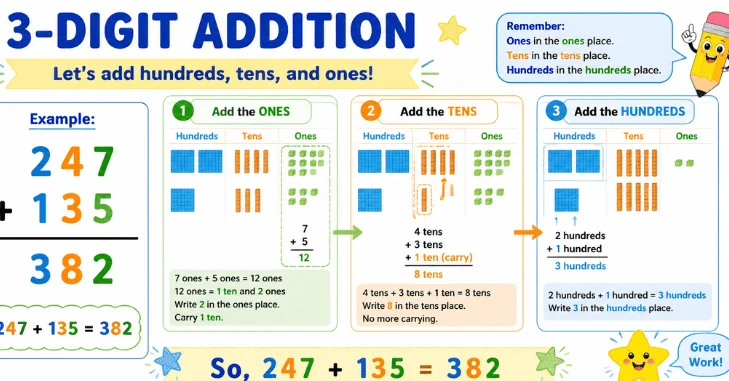
A carried digit can be easy to miss when students focus only on the two printed addends. Writing the regrouped value clearly above the next column reduces this mistake. Students should include it before calculating that column.
It also helps to name the value instead of calling every carried digit “one.” A carried 1 above the tens column represents one ten. A carried 1 above the hundreds column represents one hundred.
Teachers and parents can ask students to explain each exchange aloud. Saying “ten ones become one ten” connects the written process with place value. This habit encourages understanding instead of memorizing unexplained marks.
Common Three-Digit Addition Mistakes
Most errors come from a small group of predictable habits. Finding the type of mistake is more useful than assigning many extra problems. Students can correct the specific habit that caused the wrong answer.
| Mistake | Why It Happens | Better Habit |
|---|---|---|
| Misaligned digits | Place values do not match. | Line up numbers from the right. |
| Forgotten carry | Regrouped value is overlooked. | Write it above the next column. |
| Starting on the left | Later, regrouping changes finished work | Begin with ones. |
| Writing 12 in one column | Place-value exchange is skipped. | Write 2 and regroup one ten. |
| Ignoring the carried digit | Only printed digits are added. | Point to every number before adding. |
Students should correct an incorrect problem rather than immediately erasing everything. Looking at the original work can reveal exactly where the process changed. That makes each mistake useful practice for the next problem.
Regrouping in the Ones, Tens, or Both
Not every problem needs regrouping in the same place. One problem may regroup only the ones, while another may regroup only the tens. A third problem may require exchanges in both columns.
For example, 246 + 137 requires regrouping in the ones because 6 + 7 equals 13. The tens then include the new ten before continuing. Students should inspect each column independently instead of assuming every column needs carrying.
Problems with two regrouping steps require extra attention but follow no new rule. Students repeat the same exchange whenever a column reaches ten or more. That consistency is one reason place-value understanding matters so much.
How to Check an Addition Answer
Estimation provides a fast way to catch answers that are far from reasonable. Round each addend to the nearest hundred or ten, depending on the numbers. Then compare the approximate result with the written sum.
For 367 + 185, rounding gives about 400 + 200, or 600. Rounding to the nearest ten gives 370 + 190, or 560. The exact answer of 552 fits comfortably near those estimates.
Students can also add the numbers again after covering their first work. A second calculation may expose a forgotten carry or alignment mistake. Checking work should become part of solving, not a separate punishment after errors.
A Simple Practice Routine for Students
Short, focused practice often works better than completing a large page without feedback. Begin with problems that regroup in only one column. Then introduce problems that require regrouping twice.
A useful practice session can follow this progression:
1. Solve two problems with regrouping in the ones only.
2. Solve two problems with regrouping in the tens only.
3. Solve three problems with regrouping in both columns.
4. Estimate every answer before checking it.
5. Explain one problem aloud using place-value words.
Parents and teachers can stop after a few accurate examples. Repeating an error many times can strengthen the wrong habit. Correcting the process early keeps practice productive.
Practice Problems
Try these problems without looking at the answers first. Write each problem vertically and show every regrouped value. Estimate each answer before comparing your work.
1. 248 + 175
2. 364 + 287
3. 459 + 172
4. 586 + 239
5. 675 + 148
6. 738 + 194
Answers: 423, 651, 631, 825, 823, and 932.
Tips for Parents and Teachers
Ask students what each carried digit represents before asking for speed. Correct mathematical language helps connect the algorithm to place value. Speed usually improves after students understand the exchanges.
Visual models can help when a learner repeatedly writes two digits inside one column. Draw ten ones and exchange them for one ten. Then connect that drawing to the small digit written above the next column.
Mixing problem types can also show whether students understand the process. Include examples with no regrouping, one regrouping step, and two regrouping steps. Students then decide when an exchange is needed instead of carrying automatically.
Frequently Asked Questions
What is 3-digit addition with regrouping?
It is an addition involving three-digit numbers where one or more place-value columns total ten or more. Ten units are exchanged for one unit in the next place. Students usually work from ones to tens and then hundreds.
Why do we start adding from the one place?
Starting with ones handles any regrouping before the tens column is calculated. The same idea applies when tens regroup into hundreds. This right-to-left order keeps unfinished columns ready for new values.
Is regrouping the same as carrying?
“Carrying” commonly describes the written action of moving a value into the next column. “Regrouping” explains the place-value exchange behind that action. Both terms often refer to the same addition process.
What grade learns three-digit addition?
The timing differs across schools and state standards. Students commonly develop addition within 1,000 during the elementary grades. Individual students may encounter the written method earlier or later.
How can students improve accuracy?
Students should align digits carefully, write regrouped values clearly, and add every visible value. Estimating the final result provides another useful check. Short practice sets also make it easier to correct mistakes quickly.
Build Confidence One Column at a Time
Adding three-digit numbers becomes manageable when students treat each column as one small task. Place value explains every regrouping step and removes much of the mystery. Consistent alignment, clear carrying, and estimation build accuracy together.
Use the worked example as a model before moving to the practice problems. Encourage students to explain why each regrouping step works. Readers who want to explore other topics can continue through NewPapero’s latest articles after completing the practice set.