Unisex clothing gives shoppers options designed without strict men’s or women’s labels. These pieces often use shared silhouettes, neutral styling, and flexible sizing. The result can make everyday dressing simpler for people with different tastes and body types.
The label does not guarantee one universal fit or size standard. A medium from one brand can differ significantly from another brand’s medium. Checking garment measurements remains the safest way to choose a size.
Direct answer: Unisex apparel is designed for people of different genders rather than one traditional gender category. Most pieces use flexible cuts and shared size ranges. Fit can vary by brand, so U.S. shoppers should compare chest, waist, hip, length, and garment measurements before ordering.
| Key point | What U.S. shoppers should know |
|---|---|
| Basic meaning | Garments are designed without relying only on traditional men’s or women’s categories |
| Common pieces | T-shirts, hoodies, sweatshirts, jackets, jeans, sweatpants, and accessories |
| Typical fit | Straight, relaxed, boxy, oversized, or adaptable |
| Sizing | There is no single universal sizing standard across brands |
| Best buying method | Compare body measurements with the brand’s own size chart |
| Styling advantage | Neutral basics can work across casual, streetwear, preppy, and minimalist outfits |
| Main risk | Assuming the same letter size fits equally across every brand |
Key Takeaways
- Gender-neutral apparel focuses more on measurements, silhouette, and personal preference.
- Letter sizes such as S, M, and L can vary between retailers.
- Chest, waist, hip, inseam, and garment length often matter more than the label.
- Relaxed basics are among the easiest pieces to style across different wardrobes.
- Shoppers should decide whether they want a close, regular, relaxed, or oversized fit before sizing.
What Is Unisex Clothing and How Does It Work?
Unisex clothing is apparel created without restricting the intended wearer to one traditional gender category. Designers often achieve this through straighter cuts, flexible proportions, and broadly wearable colors. Common examples include T-shirts, hoodies, sweaters, workwear jackets, and sweatpants.
The idea is different from making every garment identical for every body. Bodies have different proportions, even when two people share the same height. Good sizing information should therefore focus on measurements instead of assumptions about gender.
Modern casualwear makes this approach especially practical. Hoodies, tees, denim, sneakers, and outerwear already cross traditional wardrobe categories easily. Newpapero’s Fashion section offers more examples of adaptable everyday styling.
Why Gender-Neutral Fashion Appeals to U.S. Shoppers
Versatility is one of the biggest reasons shoppers choose gender-neutral pieces. One sweatshirt can work with jeans, trousers, shorts, or a skirt. That flexibility can reduce the number of specialized items needed in a wardrobe.
Shared basics can also make shopping simpler for couples, families, or anyone who dislikes rigid department labels. Shoppers can focus on fabric, color, and shape instead. The useful question becomes whether a garment fits properly and suits the intended look.
The style also works well with several current wardrobe approaches. Minimalist outfits favor simple shapes and repeatable colors. Streetwear and athleisure often use relaxed proportions that already suit shared sizing.
Understanding Unisex Sizing in the United States
Unisex sizing can confuse shoppers because there is no single chart used by every retailer. Brands develop measurements around their own patterns and target fits. A size medium should never be treated as a fixed nationwide measurement.
Current retailer charts show why checking measurements matters. Reebok publishes specific chest, waist, hip, and inseam measurements for its shared-size garments. Other brands use different measurement ranges and conversion systems.
Start with your actual body measurements before buying online. Use a flexible tape around the fullest chest area, natural waist, and fullest hip area. Compare those numbers with the specific product chart rather than relying on your usual letter size.
Body Measurements Versus Garment Measurements
A body measurement describes your physical dimensions. A garment measurement describes the finished piece laid flat or measured around specific points. Mixing the two can easily lead to ordering the wrong size.
Suppose your chest measures 40 inches. A shirt measuring exactly 40 inches around the chest would leave almost no wearing ease. A relaxed garment needs additional room beyond the body measurement.
Product pages sometimes state whether listed numbers describe the body or the finished garment. Read that note before comparing measurements. If the information is unclear, customer reviews can also reveal whether a piece runs small or large.
How to Choose the Right Unisex Fit

Begin by deciding how you want the garment to look. A fitted T-shirt requires a different size choice than an oversized streetwear T-shirt. The intended silhouette should guide the size decision.
For tops, check chest width, shoulder width, sleeve length, and overall length. Shoulder placement strongly affects whether a shirt looks fitted or relaxed. Longer sleeves and dropped shoulders usually create a looser appearance.
For bottoms, focus on waist, hip, rise, and inseam measurements. Elastic waistbands create more flexibility than structured waistbands. Newpapero’s guide to styling grey sweatpants shows how fit changes the appearance of casual pieces.
Unisex Fit Compared With Traditional Men’s and Women’s Fits
| Feature | Typical unisex fit | Traditional men’s fit | Traditional women’s fit |
|---|---|---|---|
| Torso | Often straight or relaxed | Usually straighter through torso | Often shaped more at waist |
| Shoulders | Frequently broader or dropped | Usually broader | Often narrower |
| Length | Often medium to long | Often longer | May be shorter |
| Hips | Usually less shaped | Usually straighter | Often allows more hip shaping |
| Styling goal | Flexible across wearers | Built around men’s blocks | Built around women’s blocks |
These descriptions are general patterns rather than fixed rules. Individual brands can use completely different blocks and proportions. Product measurements should always outweigh assumptions based on a category name.
A shopper with narrow shoulders may size down in a boxy shared-fit shirt. Someone wanting more hip room may size according to the largest relevant measurement. Alterations can also improve length or sleeve fit without changing the overall style.
Easy Ways to Style Gender-Neutral Pieces
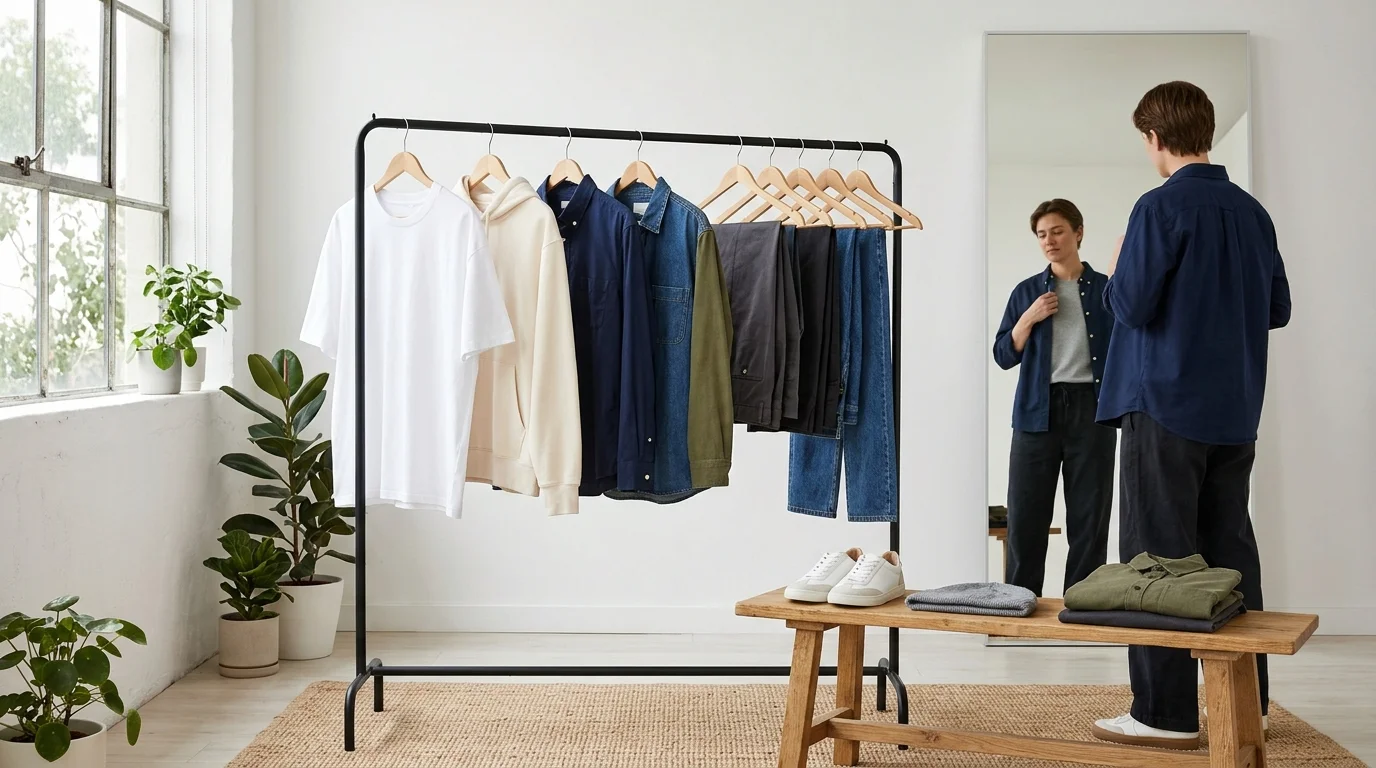
Start with pieces that naturally support multiple outfit combinations. A solid tee, relaxed sweatshirt, straight-leg pants, denim jacket, and clean sneakers create a useful foundation. Neutral colors make these garments easier to repeat.
For a casual outfit, combine a boxy tee with straight jeans and low-profile sneakers. Add a lightweight jacket for shape and contrast. Keeping two pieces relaxed and one more structured usually prevents the outfit from looking shapeless.
A polished outfit can start with a button-down shirt, straight trousers, and loafers. Navy, white, khaki, charcoal, and brown work particularly well for this approach. Readers who prefer classic American styling can also explore Newpapero’s preppy fashion guide.
Alternative styles can use the same basic principle with different colors and accessories. Black layers, boots, silver jewelry, and oversized outerwear create a darker direction. Newpapero’s guide to different goth styles offers related inspiration.
Building a Small Gender-Neutral Capsule Wardrobe
A capsule wardrobe works best when each piece connects with several others. Choose a limited color palette before buying new items. Black, white, gray, navy, olive, and tan are easy starting points.
A practical starter wardrobe could include the following pieces.
- Two solid T-shirts
- One long-sleeve shirt
- One hoodie or crewneck sweatshirt
- One button-down shirt
- One pair of straight jeans
- One pair of relaxed trousers
- One casual jacket
- One pair of versatile sneakers
Fabric choice matters as much as color. Cotton jersey works well for everyday tops, while heavier cotton adds structure. Denim, twill, fleece, and knit fabrics can add texture without complicating the color palette.
What to Check Before Buying
Never buy solely because a product carries a shared-size label. Look at the chart, model measurements, fabric composition, and stated fit. Customer photographs can also reveal how the garment hangs on different bodies.
Fabric can change the fit after several hours of wear. Stretch blends may relax around the knees or waist. Heavy cotton can feel more structured and may shrink if care instructions are ignored.
Return policies deserve attention when you are trying an unfamiliar brand. Online sizing remains easier when exchanges are straightforward. Keep packaging and tags until you know the garment works for your body.
Common Mistakes to Avoid
The first mistake is automatically ordering your normal size. Letter sizing differs too much between brands for that approach. Compare measurements every time you shop somewhere new.
Another mistake is focusing only on chest or waist measurements. Sleeve, inseam, rise, and total length can change how an outfit looks. Proportion often matters as much as whether a garment technically fits.
Shoppers also sometimes confuse oversized with simply buying several sizes larger. Purpose-built oversized garments usually adjust shoulders, sleeves, and body width together. Randomly sizing up can create excess length in unwanted areas.
Is Unisex Fashion the Same as Gender-Neutral Fashion?
The terms overlap, but brands do not always use them identically. “Unisex” often describes products marketed for different genders using one shared design. “Gender-neutral” can place greater emphasis on avoiding gendered categories altogether.
For shoppers, the practical difference is usually less important than the actual garment. Study the cut, measurements, fabric, and styling images. Those details reveal more about fit than marketing terminology alone.
Androgynous fashion can also overlap with these categories without meaning exactly the same thing. It often refers to an aesthetic that combines or avoids traditionally masculine and feminine style signals. A person can wear shared-size basics without aiming for an androgynous appearance.
Frequently Asked Questions
How does unisex clothing sizing work?
Unisex clothing usually uses one shared size range, such as XS through XXL. Each brand sets its own chest, waist, hip, and length measurements. Always compare your measurements with the specific retailer’s chart before ordering.
Should women size down in unisex shirts?
Sometimes, but there is no universal rule. A person may size down when a shirt uses broader shoulders or a straighter cut. The desired silhouette and product measurements should determine the final choice.
Are unisex sizes the same as men’s sizes?
Not necessarily. Some brands base shared sizing on a traditionally masculine block, while others create a separate pattern. The size chart provides a more reliable answer than the label.
What pieces work best for a gender-neutral wardrobe?
T-shirts, hoodies, overshirts, straight trousers, denim, sneakers, and simple outerwear are useful starting points. These pieces combine easily and support several style directions. Neutral colors make mixing outfits even easier.
Can unisex garments still be fitted?
Yes, shared sizing does not require an oversized silhouette. A garment can use a slim, regular, relaxed, or boxy fit. Product descriptions should explain which shape the designer intended.
A Better Way to Shop for Fit
Treat size labels as starting points instead of guarantees. Measure your body, study the garment chart, and decide how much ease you prefer. That process works better than automatically choosing the same letter size everywhere.
Pay attention to proportions once the garment arrives. Check shoulders, sleeve length, waist placement, rise, and overall length in a full-length mirror. Keep the piece only when those details support the look you wanted.
A flexible wardrobe does not need complicated rules. Choose pieces that fit your body, match your daily routine, and work with items you already own. For more outfit ideas, continue through Newpapero’s Fashion coverage.