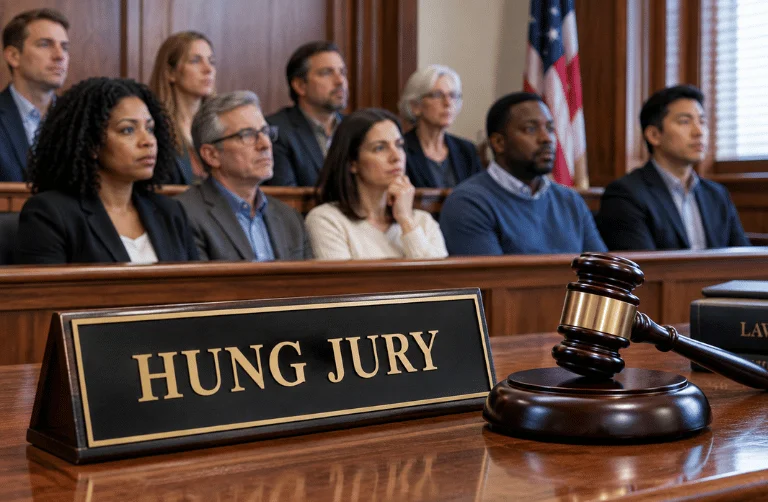
If you hear that a trial ended with a hung jury, it means the jurors could not reach the agreement required for a valid verdict. The defendant has not been convicted, but the result usually is not an acquittal either. Depending on the case, the judge may declare a mistrial, and prosecutors may get another opportunity to bring the charges before a new jury.
Direct answer: A deadlocked jury occurs when jurors cannot reach the agreement required for a verdict. In a U.S. criminal case, that usually means no conviction or acquittal is entered on the unresolved charge; the judge may declare a mistrial, and prosecutors may choose to retry the case.
| Key point | What it means |
|---|---|
| Also called | Deadlocked jury |
| Criminal verdict requirement | Unanimity is required to convict in federal and state criminal trials involving non-petty offenses |
| Immediate result | The judge may order more deliberation or declare a mistrial. |
| Is it an acquittal? | No |
| Can the case be retried? | Generally yes on charges where no verdict was reached |
| Double jeopardy | Usually does not prevent retrial after a mistrial caused by genuine jury deadlock |
| Partial verdict possible? | Yes, in some cases involving multiple counts or defendants |
| Civil cases | Federal civil verdicts generally require unanimity unless the parties agree otherwise; state rules vary. |
Key Takeaways
- A jury disagreement does not immediately end a trial.
- Judges can ask jurors to continue deliberating before declaring a mistrial.
- Deadlock is different from an acquittal because no final verdict has been reached.
- Prosecutors can generally retry unresolved criminal charges with a new jury.
- Federal rules allow partial verdicts when jurors agree on some counts but not others.
- Civil jury requirements can differ, especially between federal and state courts.
What Does a Hung Jury Mean in U.S. Court?
A hung jury means the jurors have deliberated but cannot reach the level of agreement needed for a valid verdict. The term “deadlocked jury” means the same thing. Cornell Law School’s Legal Information Institute explains that a deadlock can lead the judge to send jurors back for more deliberation or eventually declare a mistrial.
The unanimity rule is especially important in U.S. criminal cases. In Ramos v. Louisiana, decided in 2020, the Supreme Court held that the Sixth Amendment requires a unanimous verdict to convict a defendant of a serious criminal offense in both federal and state courts. Congress’s Constitution Annotated reflects that rule under current constitutional doctrine.
Readers interested in other plain-English legal topics can browse NewPapero’s Law section. The site also explains formal terminology in its guide to the meaning of “inchoate,” including how that word appears in legal contexts. Understanding these terms can make court reporting and legal documents easier to follow.
Why Do Juries Become Deadlocked?
Jurors can disagree because they interpret testimony, physical evidence, witness credibility, or the law differently. Criminal jurors must decide the case for themselves rather than vote with the majority simply to finish deliberations. Federal model jury instructions tell jurors to discuss the case fully while preserving each juror’s conscientious judgment.
Deadlock usually comes from a few recurring disagreements.
- Jurors take different views about whether the prosecution proved an element beyond a reasonable doubt.
- Jurors disagree about whether a witness was credible.
- Jurors read expert testimony or other evidence in conflicting ways.
- Jurors are unsure how the judge’s legal instructions apply to the facts.
- One or more jurors keep a position after lengthy discussion.
A split vote alone does not necessarily mean deliberations are finished. Judges usually need a basis for concluding that the disagreement has become genuine and cannot reasonably be resolved through further discussion. Federal appellate guidance describes a true deadlock as an irreconcilable disagreement and recognizes that a mistrial requires a sufficiently serious need.
What Happens After Jurors Report That They Cannot Agree?
The judge does not always end the trial as soon as jurors send a note saying they are stuck. Courts often give the panel more time, clarify an instruction, or provide a supplemental instruction encouraging continued discussion. That instruction should encourage thoughtful deliberation without telling a juror to abandon an honestly held view merely to produce a verdict.
A typical sequence looks like this:
- The jury reports a deadlock. The foreperson informs the court that an agreement has not been reached.
- The judge evaluates the situation. The judge may consider how long the jury has deliberated, the case’s complexity, and previous communications.
- Further deliberation may be ordered. Jurors can be instructed to keep discussing the evidence and each other’s views.
- A mistrial may be declared. If continued deliberation appears unlikely to produce a valid verdict, the court can discharge the jury.
Federal Criminal Rule 31 also allows a court to deal separately with counts on which jurors agree and counts on which they remain divided. If the jury cannot agree on one or more counts, the court may declare a mistrial on those particular counts. The government may then retry unresolved counts, subject to other applicable legal limits.
Deadlock, Mistrial, Acquittal, and Conviction Are Different
These terms are often used together in news coverage, but they describe different legal events. A jury deadlock describes the jurors’ inability to reach the required decision, while a mistrial is an action taken by the court that ends a trial without a final determination on the unresolved matter. An acquittal and conviction, by contrast, are actual outcomes of guilt.
| Outcome | Guilty verdict? | Not-guilty verdict? | Charges resolved? | Retrial generally possible on that charge? |
|---|---|---|---|---|
| Jury deadlock followed by mistrial | No | No | No | Yes. |
| Acquittal | No | Yes. | Yes. | Generally no |
| Conviction | Yes. | No | Yes. | The case moves to post-trial proceedings or appeal. |
| Partial verdict | Depends on count | Depends on count | Only some counts | Possible on unresolved counts |
This distinction matters most when someone sees “mistrial” in a headline and assumes the defendant won. A mistrial caused by jury deadlock generally leaves the disputed charge unresolved rather than deciding it in the defendant’s favor. The parties may therefore return to court for another trial, negotiate a different resolution, or see prosecutors decide not to proceed.
Can Prosecutors Retry a Case After Jury Deadlock?
After a hung jury leads to a properly declared mistrial, prosecutors generally can try the unresolved criminal charge again. The Supreme Court has long treated genuine jury deadlock as a circumstance that permits a trial to end without barring another prosecution. A second trial uses a new jury, although the evidence, witnesses, charges, or litigation strategy may change.
Retrial is not automatic, because prosecutors still need to decide whether pursuing another case makes sense. They may review the evidence, the apparent jury split, witness availability, legal rulings, resources, and the seriousness of the charge. Depending on the jurisdiction and facts, prosecutors may retry the case, negotiate a plea, modify charges where legally permitted, or decline further prosecution.
Why Double Jeopardy Usually Does Not Stop a Retrial
The Fifth Amendment protects people from being placed twice in jeopardy for the same offense, but jury deadlock has a special place in that doctrine. In Richardson v. United States, the Supreme Court held that a mistrial following a deadlocked jury does not terminate the original jeopardy in the way an acquittal does. For that reason, retrying an unresolved count generally does not violate the Double Jeopardy Clause.
That rule should not be read to mean every mistrial permits another prosecution. Double-jeopardy questions can become more complicated when a mistrial occurs for another reason, when an acquittal has already been entered, or when different counts have different outcomes. Anyone whose own criminal case has ended without a verdict should get advice based on that case’s record and jurisdiction.
Can Jurors Reach a Verdict on Some Charges but Not Others?
Yes, a criminal jury can sometimes agree on some counts while remaining divided on others. Federal Rule of Criminal Procedure 31, which governs jury verdicts, specifically provides for partial verdicts in cases involving multiple defendants or multiple counts. A court can accept the verdicts that have been reached and address the unresolved portions separately.
For example, imagine a defendant faces three separate counts. Jurors might unanimously acquit on one count, convict on another, and remain unable to agree on the third. The completed verdicts can have legal effect, while the unresolved count may become the subject of a mistrial and possible retrial.
This is one reason a news report saying a jury “could not agree” may not tell the full story. You need to know whether the panel was divided on the entire case or only on a particular charge or defendant. The court’s final order and verdict forms provide the clearest answer.
Can Jury Deadlock Happen in Civil Cases?
Yes, disagreement can also prevent a valid verdict in civil litigation when the applicable rules require a particular level of agreement. Under Federal Rule of Civil Procedure 48, a federal civil jury’s verdict must generally be unanimous unless the parties stipulate otherwise. If polling shows the required agreement is missing, the judge may direct further deliberations or order a new trial.
State civil rules can differ, so the criminal-law unanimity rule should not be applied automatically to every civil lawsuit. The voting requirement may depend on the state, court, type of case, and agreements between the parties. That distinction is especially important for readers comparing federal litigation with state disputes.
NewPapero also covers practical civil-law issues, including what can happen when one co-owner refuses to sell shared property. That dispute is legally different from jury procedure, but it shows why state-specific rules can matter in civil cases. General explanations are useful starting points, while the governing jurisdiction determines the actual procedure.
What Does a Deadlocked Trial Mean for the People Involved?
For a defendant, a mistrial caused by deadlock means the immediate trial has ended without a conviction on the unresolved charge. It does not necessarily mean the criminal case itself is finished, and existing bail or custody questions may require additional court decisions. A defense lawyer will usually assess whether the prosecution intends to retry the case and whether any motions should be filed before another trial.
For prosecutors, the result creates a new strategic decision. They must decide whether another trial is justified by the evidence, public interest, available witnesses, and realistic chance of obtaining a verdict. A prior trial can also reveal how jurors reacted to key evidence, although jury deliberations themselves remain subject to important privacy rules.
Jurors are discharged when the court ends their service, and a later retrial uses a newly selected jury. The new panel must decide the case from the evidence and law presented in the new proceeding. It does not simply continue the earlier jury’s unfinished deliberations.
Frequently Asked Questions
Does a hung jury mean not guilty?
No, a hung jury does not itself mean that the defendant has been found not guilty. It means the jurors did not reach the required verdict on the unresolved charge. If the judge declares a mistrial, prosecutors may generally pursue another trial rather than treating the result as an acquittal.
Can one juror prevent a criminal conviction?
In a U.S. criminal case where a unanimous verdict is constitutionally required, one dissenting juror can prevent a guilty verdict from being returned. The Supreme Court’s Ramos decision established that unanimity is required to convict defendants of serious criminal offenses in state as well as federal courts. A single disagreement does not guarantee an immediate mistrial because the judge may permit further deliberation.
Can a judge force jurors to agree?
A judge can direct jurors to continue deliberating and may provide lawful supplemental instructions, but jurors should not surrender an honest judgment merely to create unanimity. Federal jury instructions tell each juror to decide the case individually after fully considering the evidence and other jurors’ views. If genuine deadlock remains, the court can eventually declare a mistrial.
How many times can prosecutors retry after a deadlocked trial?
There is no simple nationwide rule saying prosecutors always receive only one additional attempt after jury deadlock. Constitutional and procedural limits depend on what happened in the earlier proceedings, the charges involved, judicial rulings, and applicable state or federal law. Repeated prosecutions can raise complex issues, so a defendant in that situation needs advice from a lawyer familiar with the complete record.
The Bottom Line
A jury that cannot reach the required agreement leaves a case in a different position from one that ends in conviction or acquittal. The judge may allow more deliberation, accept partial verdicts where permitted, or declare a mistrial on unresolved charges. Prosecutors can generally seek another trial after genuine deadlock because the Supreme Court does not treat that type of mistrial as an acquittal for double jeopardy purposes.
If you are involved in an actual criminal or civil case, use this explanation as general background rather than legal advice. Court rules vary by jurisdiction, and small procedural details can change the result. Speak with a licensed attorney in the relevant state or federal jurisdiction if you need guidance about a real case.