
Choosing a business structure affects who controls the company, how profits reach owners, and whether business debts can put personal assets at risk. An LLLP, or limited liability limited partnership, is designed for ventures that want the traditional separation between managing partners and passive investors without exposing managing partners as much as they might be in a standard limited partnership. It can be useful in real estate, investment, and closely held ventures, but its usefulness depends heavily on the law of the state where the partnership is organized and operates.
An LLLP is a limited partnership in which both general partners and limited partners receive liability protection for many partnership obligations. It preserves separate management and investor roles while reducing a key liability risk of a traditional LP, although state recognition, filing requirements, and the exact scope of protection vary.
What Does LLLP Stand For?
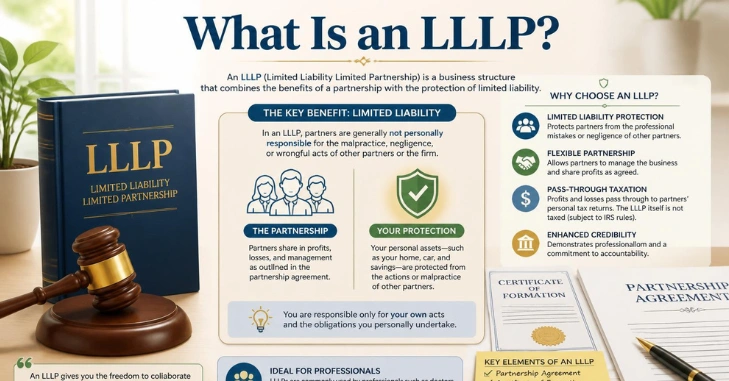
LLLP stands for limited liability limited partnership. The structure starts with the basic model of a limited partnership, which has at least one general partner and at least one limited partner. Still, it adds liability protection for the general partner or partners. In a traditional LP, the general partner typically manages the venture, while limited partners primarily contribute capital and stay less involved in management.
That extra layer of protection is what distinguishes the form from a conventional LP. General partners can retain management responsibility without automatically becoming personally responsible for every partnership debt merely because they are general partners. In contrast, limited partners continue to receive the protection traditionally associated with their investor role. Liability protection is not absolute, however, because an individual can still face responsibility for personal wrongdoing, guarantees, or other circumstances recognized by applicable law.
How an LLLP Works
The structure normally keeps two classes of owners: general partners and limited partners. General partners typically make operating decisions, negotiate contracts, direct strategy, and handle the partnership’s day-to-day affairs. In contrast, limited partners typically provide capital and hold a more passive financial interest. This division can make the structure attractive when a venture needs active managers and investors who do not want to participate in everyday operations.
The key difference is liability treatment. In an ordinary limited partnership, limited partners generally have liability protection. In contrast, a general partner can face personal exposure for partnership obligations, but this form is intended to extend a liability shield to the general partners as well. This allows the venture to preserve an LP-style management hierarchy while reducing one of the main reasons owners might otherwise avoid becoming general partners.
LLLP vs. LP vs. LLP vs. LLC
The similar abbreviations make these structures easy to confuse, but they solve different ownership and management problems. This form is especially distinctive because it combines the general-partner/limited-partner hierarchy of an LP with broader liability protection. An LLC, meanwhile, uses members rather than general and limited partners and normally offers considerably more flexibility for businesses that do not need two formal classes of owners.
| Structure | Ownership and management | General liability approach | Common reason to consider it |
| LLLP | General partners manage; limited partners are generally passive | Both classes receive significant liability protection under applicable state law | Investments or ventures needing active managers plus passive investors |
| LP | General partners manage; limited partners generally invest | Limited partners are protected, while general partners can face personal exposure | Ventures that need a clear manager-investor split |
| LLP | Partners are generally on more equal management footing | Partners generally receive protection from partnership obligations, subject to state law | Professional or multi-owner partnerships |
| LLC | Members may manage directly or appoint managers | Members generally receive limited liability | Broad range of operating businesses and startups |
The choice is therefore not simply about which abbreviation offers the most protection. Founders also need to consider management rights, the number and type of owners, the states in which the venture will operate, tax consequences, financing plans, and administrative requirements. For broader business-planning topics beyond entity selection, readers can also explore Newpaper’s business coverage.
The Main Advantages of an LLLP
The strongest argument for an LLLP is that it can protect the managers without eliminating the distinction between active and passive partners. A traditional LP may force organizers to choose between managerial control and personal liability exposure. In contrast, the structure is intended to give a general partner both management authority and a statutory liability shield. That can be particularly valuable when the partnership owns expensive assets or takes on meaningful contractual obligations.
The structure can also work well when investors want economic participation without equal responsibility for running the venture. Instead of giving every owner the same management role, the partnership agreement can clearly divide those directing the business from those primarily supplying capital. This is one reason these partnerships are commonly associated with investment-oriented and real-estate ventures.
The structure may also preserve the familiar federal tax framework used by partnerships. Partnerships generally file Form 1065 to report income, gains, losses, deductions, and other items. Profits and losses generally pass through for partners to report on their own returns rather than being subject to federal income tax at the partnership level. Each partner’s tax consequences can differ substantially, so don’t base entity selection on the phrase “pass-through taxation” alone.
The Disadvantages and Risks
The biggest practical limitation is that LLLPs are not recognized uniformly across the United States. A 2026 NerdWallet review notes recognition in roughly 30 states, meaning organizers must verify the current law where they plan to form and conduct business rather than assuming the structure receives identical treatment nationwide. Operating across state lines can create additional questions about registration and whether another jurisdiction will give the general partners the same protection expected in the formation state.
Formation can also be more complicated than setting up a familiar LLC. State procedures differ, and some jurisdictions treat the arrangement as a limited partnership, requiring an additional liability-related registration or election rather than a completely separate entity type. Texas, for example, explains that a limited partnership can register as an LLP and use “limited liability limited partnership” or “LLLP” in its legal name, showing why you should check state-specific filing rules before preparing documents.
Another disadvantage is that the arrangement may add complexity without producing a meaningful benefit for every business. A small operating company with owners who all expect to participate equally may find an LLC easier to understand and administer. At the same time, a solo founder cannot create the traditional general-partner/limited-partner relationship by themselves. The structure makes the most sense when its two-tier ownership model serves a real business purpose, not when it is chosen simply because it sounds more protective.
How Is an LLLP Taxed?
For federal income tax purposes, this kind of partnership generally follows partnership taxation. Form 1065 reports partnership activity, and the partnership generally passes taxable items through to its partners instead of paying federal income tax on ordinary partnership income at the entity level. Partners then account for their allocated items on their own tax returns.
Self-employment tax requires more care because the words “general partner” and “limited partner” can matter. The IRS states that partners performing services are generally self-employed, not employees. In contrast, qualifying limited partners can receive different self-employment-tax treatment for distributive shares and guaranteed payments. IRS materials also specifically note that determining who qualifies for the limited-partner exception can become more complicated in entities whose owners have limited liability, including LLLPs.
For that reason, forming an LLLP solely to obtain a particular self-employment-tax result is risky. The federal tax analysis can depend on the partner’s role, services, compensation, the partnership agreement, and current tax authority, not merely the letters printed after the business name. A CPA, enrolled agent, or tax attorney familiar with partnership taxation should review the arrangement before owners rely on a projected tax advantage.
Which Businesses Commonly Use LLLPs?
Real-estate ventures are one of the clearest examples because they often naturally separate managers from investors. One or more general partners may locate properties, negotiate financing, supervise development, sign leases, or oversee asset management. In contrast, limited partners contribute capital and expect investment returns without running everyday operations. NerdWallet identifies real estate as one of the most common uses for the LLLP structure.
Ownership structure becomes especially important whenever multiple people invest in property together because control rights and exit rights can later become major sources of disagreement. Direct co-ownership and partnership ownership are legally different arrangements. Still,Newpaper’ss discussion of what can happen when one co-owner refuses to sell shared property demonstrates why investors should define decision-making and exit procedures before committing significant money. A well-drafted partnership agreement can address voting thresholds, transfers, buyouts, distributions, management powers, and dissolution procedures before disagreements arise.
Investment funds, family investment ventures, and closely held asset-management arrangements can also have reasons to consider the structure. The common thread is not a particular industry but a desire to divide participants into active managers and more passive capital providers while protecting both groups from many entity-level obligations. Businesses in which every owner expects the same management authority may have less reason to use this model.
How to Form an LLLP
Because formation law is state-specific, no single filing procedure works everywhere in the United States. Some jurisdictions allow an appropriate limited partnership to elect or register for additional liability protection, while procedures, fees, naming rules, registered-agent requirements, and ongoing reports can differ. Texas alone demonstrates how technical the distinction can become, because its Secretary of State describes an LLP as a registration made by an underlying partnership rather than a separate entity created by the registration itself.
A sensible formation sequence is:
- Confirm that your state recognizes the structure. Check the current Secretary of State or equivalent business-filing agency rather than relying solely on a generic national list.
- Choose the general and limited partners. Define which participants will manage the venture and which will primarily contribute capital.
- Prepare the underlying partnership and required filings. The exact documents depend on state law and may require forming an LP before obtaining additional liability protection.
- Draft a detailed partnership agreement. Cover capital contributions, management authority, voting, distributions, transfers, new investors, partner exits, disputes, and dissolution.
- Complete tax and operational registrations. Obtain required federal and state tax identification, licenses, bank accounts, and other registrations appropriate to the venture.
- Review multistate activity before expanding. A partnership doing business outside its formation state may face foreign-registration requirements and different liability-status treatment.
Formation is only the beginning of managing a business successfully. Entity protection does not replace sound budgeting, contracts, insurance, recordkeeping, and operating controls, just as business profitability requires disciplined working-capital allocation. Newpapero’s guide to merchandising strategy and financial metrics provides a practical example of how operational decisions continue to affect cash and profitability after a legal entity has been created.
Is an LLLP Right for Your Business?
The structure is worth investigating when a venture genuinely needs two types of participants. If one group is expected to control operations while another group primarily supplies capital, the structure can preserve that hierarchy while offering managers stronger liability protection than a conventional limited partnership may provide. It can be particularly relevant for real-estate holdings, investment arrangements, and other multi-owner projects built around a manager-investor model.
It is less compelling when every owner plans to participate equally, when the company has only one owner, or when the business expects to operate extensively in jurisdictions where LLLP treatment is uncertain. In those situations, an LLC or another structure may provide a more familiar and portable framework without the added general-partner/limited-partner distinction. The correct answer depends on the venture’s ownership, financing, management, tax position, and geographic footprint.
The best decision process therefore begins with the business model rather than the entity acronym. Decide who should control the venture, who will supply capital, what risks to isolate, how to allocate profits, and where the business will operate before comparing legal structures. Once those answers are clear, a business attorney and tax professional can determine whether an LLLP actually provides an advantage under the relevant state and federal rules.
The Bottom Line
An LLLP combines the management-and-investor structure of a limited partnership with additional liability protection for its general partners. That combination can be valuable for real estate and investment ventures where a smaller group manages assets on behalf of passive investors. Its biggest drawback is that availability and legal treatment vary across the United States, making state-specific research essential.
For businesses that fit the model, the structure can balance control, outside investment, partnership taxation, and liability management. For businesses that do not need separate classes of active and passive owners, a more familiar structure such as an LLC may be easier to operate. Before filing, have a qualified business attorney and tax professional review the proposed ownership arrangement, applicable state law, multistate activity, and expected federal tax treatment.
Frequently Asked Questions
What is an LLLP in simple terms?
An LLLP is a limited partnership designed to protect both its general partners and limited partners from liability. General partners normally manage the venture, while limited partners generally act more like passive investors. Its exact protections and formation requirements depend on the state involved.
What is the difference between an LP and an LLLP?
Both structures normally have general partners and limited partners, but the liability treatment of the general partners is the major difference. In a standard LP, general partners can face personal liability for partnership obligations, whereas an LLLP is intended to extend limited-liability protection to them. Limited partners generally receive liability protection under both structures.
Is an LLLP the same as an LLP?
No, although the names are similar. An LLP generally does not depend on the same general-partner and limited-partner hierarchy. At the same time, an LLLP preserves those separate roles because it is based on a limited partnership structure. State statutes can define and regulate both forms differently, so you should always check the law governing the particular partnership.
Are LLLPs recognized in every state?
No. Recognition and formation procedures vary across the United States, and current secondary guidance indicates that only roughly 30 states recognize the structure in some form. Anyone considering an LLLP should verify current rules directly with the relevant state’s filing authority and obtain advice about any other states where the partnership expects to conduct business.
Does an LLLP protect partners from every lawsuit?
No liability structure gives owners absolute immunity from every claim. It can protect partners from many obligations arising solely from their ownership status. However, people can still be liable for their own wrongful conduct, personal guarantees, and other obligations that fall outside the statutory liability shield. The scope of protection ultimately depends on applicable law and the facts of the claim.
Is an LLLP better than an LLC?
Neither structure is universally better because they serve different ownership arrangements. An LLLP can be useful when a business wants general partners to manage and limited partners to invest primarily. At the same time, an LLC often offers simpler, more flexible management for ordinary operating businesses. Evaluate state availability, taxes, financing, investor expectations, and long-term plans before choosing between them.