


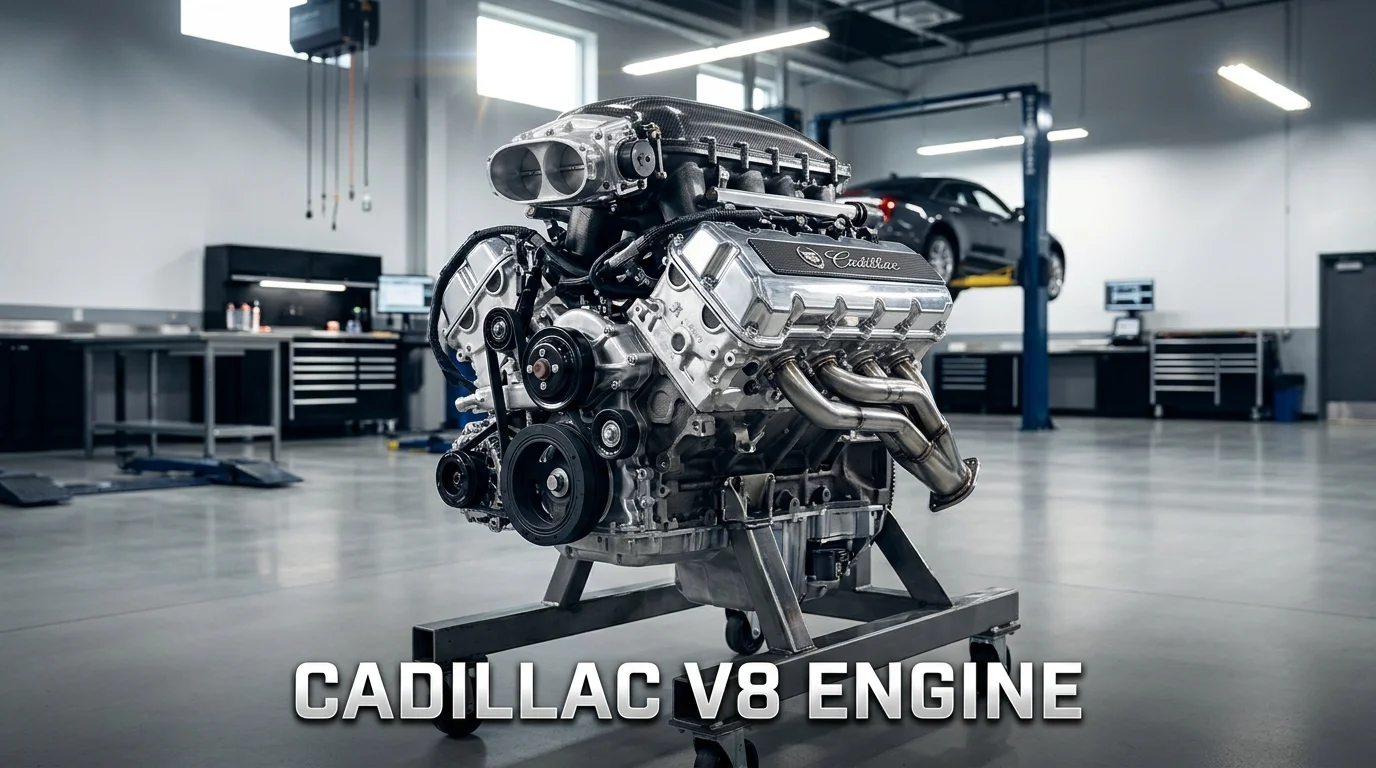
The Cadillac V8 engine has powered American luxury cars for more than a century. Today, V8 power remains available in select performance sedans and full-size SUVs. Cadillac also uses the engine type to connect its modern cars with a long engineering history. Cadillac’s current V8 offerings include naturally aspirated and supercharged 6.2-liter engines. The CT5-V Blackwing and Escalade-V represent the highest-performance applications. U.S. shoppers should also understand the important difference between the Blackwing model name and Cadillac’s earlier Blackwing engine.
Quick answer: Cadillac currently uses V8 power in select high-performance and luxury models. The CT5-V Blackwing uses a 6.2-liter supercharged V8 rated at 668 horsepower. The Escalade-V uses a hand-built 6.2-liter supercharged V8 rated at 682 horsepower. Earlier Cadillac V8 families included the Northstar and 4.2-liter twin-turbo Blackwing.
| Key point | What U.S. readers should know |
|---|---|
| Current performance sedan | CT5-V Blackwing |
| CT5-V Blackwing output | 668 hp and 659 lb-ft |
| Current performance SUV | Escalade-V |
| Escalade-V output | 682 hp and 653 lb-ft |
| Historic milestone | Cadillac introduced a mass-produced V8 in 1915 |
| Famous modern family | 4.6L Northstar |
| Cadillac-exclusive Blackwing engine | 4.2L twin-turbo DOHC V8 |
| Blackwing model-name warning | CT5-V Blackwing does not use the 4.2L Blackwing engine |
Which Cadillac Models Still Have V8 Engines?
Cadillac has reduced the number of eight-cylinder vehicles as its lineup expands into electric models. V8 power remains important in several performance-focused vehicles, though. The clearest examples are the CT5-V Blackwing and Escalade-V sold in the United States. The CT5-V Blackwing uses a supercharged 6.2-liter V8 producing 668 horsepower and 659 lb-ft of torque. Cadillac pairs it with a standard six-speed manual or an available 10-speed automatic. Cadillac lists a 3.4-second 0-to-60 mph time for the performance sedan. The Escalade-V also uses a 6.2-liter supercharged V8, but Cadillac rates this application at 682 horsepower.
Torque reaches 653 lb-ft, and the engine is assembled by hand. Cadillac estimates a 4.4-second 0-to-60 mph run despite the SUV’s considerable size. Readers interested in broader automotive coverage can browse Newpapero’s Automobile section. The site also maintains a technology section covering machines and technical subjects. Those sections provide useful context as Newpapero expands its automotive coverage.
Cadillac V8 Engine History: More Than a Century of Development
Cadillac’s relationship with eight-cylinder power stretches back to the early automobile era. The company introduced its first mass-produced V8 for the 1915 model year. That achievement helped establish the configuration as a practical choice for premium American cars. A major change arrived in 1949 with Cadillac’s modern overhead-valve V8. The 331-cubic-inch engine used high compression and a relatively short stroke. Cadillac rated the design at 160 horsepower as postwar performance competition began accelerating. Engine displacement increased dramatically during later decades.
Cadillac eventually offered 472- and 500-cubic-inch designs during the large-car era. Those engines prioritized effortless low-speed torque for heavy luxury vehicles rather than high-rpm performance. The company also experimented with efficiency as fuel-economy pressure increased. Its 1981 V8-6-4 system could deactivate cylinders under lighter operating conditions. Later High Technology engines arrived in 4.1-, 4.5-, and 4.9-liter forms.
Why the Northstar V8 Was So Important
The Northstar represented one of Cadillac’s largest departures from traditional American pushrod engine design. It used dual overhead camshafts, aluminum construction, and four valves per cylinder. Cadillac introduced the 4.6-liter Northstar in the early 1990s. Early Northstar versions produced substantially more specific output than many older Cadillac engines. The L37 version used in models including the Allanté produced about 295 horsepower.
Other versions were tuned differently to favor torque or specific vehicle requirements. Cadillac later developed a supercharged 4.4-liter Northstar for high-performance V-Series applications. That version powered vehicles including the STS-V and XLR-V. Northstar production ended in 2010 after a long run across several General Motors models.
The 4.2-Liter Blackwing Was a Different Engine
The term “Blackwing” can create confusion because Cadillac has used it in two different ways. Cadillac developed a 4.2-liter twin-turbo DOHC V8 carrying the LTA engine code. The company later used Blackwing as the performance designation for CT4-V and CT5-V models. The original LTA was an advanced Cadillac-specific engine with two turbochargers mounted within the cylinder-bank valley. It used direct injection, charge cooling, variable camshaft timing, and cylinder deactivation.
In the CT6-V specification, the engine produced up to 550 horsepower and substantial low-speed torque. A CT5-V Blackwing does not contain that 4.2-liter twin-turbo engine. Instead, it uses GM’s supercharged 6.2-liter LT4 architecture. The CT4-V Blackwing goes further from the original meaning because it uses a twin-turbocharged V6.
How Modern Cadillac V8s Compare
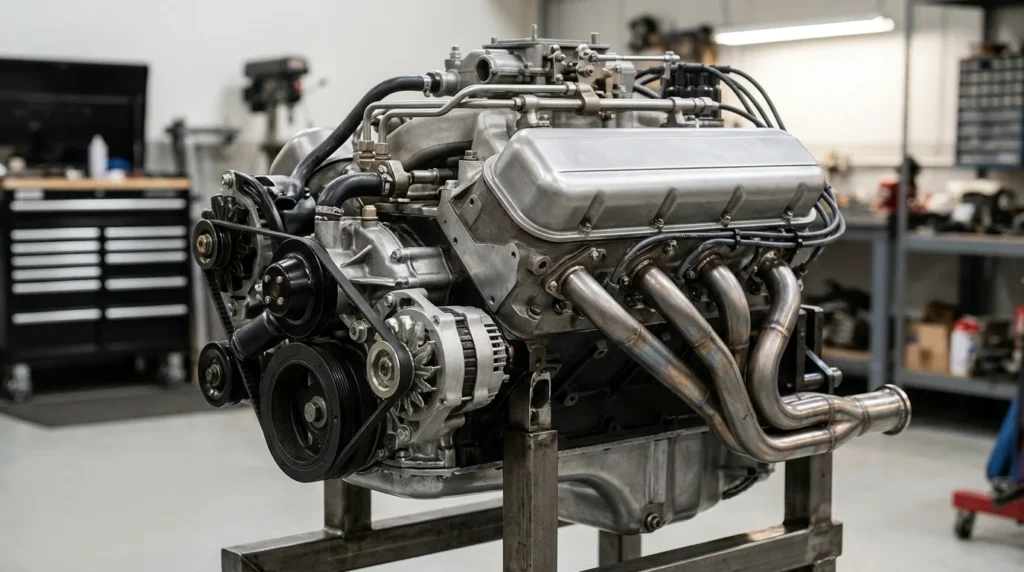
Modern Cadillac applications show how different engine designs can serve different vehicles. The CT5-V Blackwing favors driver engagement, high output, and track capability. The Escalade-V uses immense supercharged power to move a much larger luxury SUV.
| Model | Engine | Horsepower | Torque | Transmission |
|---|---|---|---|---|
| CT5-V Blackwing | 6.2L supercharged V8 | 668 hp | 659 lb-ft | 6-speed manual or 10-speed automatic |
| Escalade-V | 6.2L supercharged V8 | 682 hp | 653 lb-ft | Automatic |
| Historic CT6-V | 4.2L twin-turbo DOHC V8 | Up to 550 hp | Up to 627 lb-ft | 10-speed automatic |
The CT5-V Blackwing is the stronger choice for drivers wanting a traditional performance-sedan experience. Its available manual transmission is especially unusual among modern luxury cars. Cadillac describes it as a track-capable model rather than simply a more powerful CT5. The Escalade-V serves a different buyer because it combines three-row utility with extreme output. It offers all-wheel drive and performance hardware suited to its greater mass. Its 682-horsepower rating makes it one of Cadillac’s most powerful production road vehicles.
Are Cadillac V8 Engines Reliable?
Reliability depends heavily on the specific engine family, model year, maintenance record, and vehicle use. A century of Cadillac engines cannot be judged as one design. Buyers should research the exact engine code and model year before buying. That point matters especially for certain recent Escalades equipped with the L87 6.2-liter V8. General Motors recalled certain 2021 through 2024 Escalade and Escalade ESV vehicles in 2025. NHTSA documents identify possible connecting-rod or crankshaft manufacturing defects that can cause engine damage or failure.
NHTSA states that warning signs can include unusual knocking or banging noises. Drivers might also see a check-engine light or experience hesitation and reduced propulsion. Owners should check their individual VIN because the recall applies only to affected vehicles. The recall should not be treated as proof that every 6.2-liter Cadillac engine is unreliable. It concerns specific L87-equipped vehicles within identified production periods. Buyers considering a used Escalade should verify recall completion and review service records before purchase.
Cadillac V8s Versus Electric Performance
Cadillac is now developing high-performance vehicles with both combustion and electric powertrains. Its V-Series lineup includes V8-powered models alongside electric vehicles such as LYRIQ-V. That mix makes the current period unusual in Cadillac performance history. Electric motors deliver power differently because peak torque can arrive almost immediately. Internal-combustion V8s build their character through engine speed, gearing, exhaust sound, and mechanical response.
Readers interested in electric-machine fundamentals can also see Newpapero’s guide to the main parts of a motor. The difference means horsepower alone cannot describe the driving experience. A supercharged sedan with a manual gearbox feels different from an electric performance vehicle. Cadillac currently gives U.S. performance buyers access to both approaches.
What to Check Before Buying a Used V8 Cadillac
A used performance Cadillac deserves more inspection than a basic commuter vehicle. Powerful engines can place greater loads on cooling, braking, driveline, and suspension components. Previous track use or aggressive driving can also affect long-term ownership costs. Consider these checks before buying:
* Confirm the exact engine code and model year. * Review maintenance and repair records. * Check the VIN for open safety recalls. * Listen for unusual startup, idle, or acceleration noises. * Inspect for coolant or oil leaks. * Check transmission behavior under light and heavy acceleration. * Examine brakes and tires for excessive wear. * Arrange an independent pre-purchase inspection.
A clean service history can be more useful than mileage alone when comparing two vehicles. Performance models also need appropriate tires, fluids, and replacement parts. Budget for those costs before deciding whether the purchase fits your needs.
Frequently Asked Questions
What is the most powerful Cadillac V8 engine in a current production vehicle?
The Escalade-V’s supercharged 6.2-liter V8 is rated at 682 horsepower and 653 lb-ft. The CT5-V Blackwing produces 668 horsepower and 659 lb-ft. Cadillac also announced a limited 2026 F1 Collector Series version with 685 horsepower.
What Cadillac still has a V8?
U.S. buyers can find V8 power in vehicles including the CT5-V Blackwing and Escalade-V. Other Escalade configurations have also offered 6.2-liter V8 power. Availability can vary by model year and trim.
Is the Cadillac V8 engine the same as the Blackwing engine?
Not necessarily. The original Blackwing engine was a 4.2-liter twin-turbo DOHC V8 used in the CT6. The current CT5-V Blackwing instead uses a supercharged 6.2-liter V8.
When did Cadillac first make a V8?
Cadillac introduced a mass-produced V8 for the 1915 model year. The design became an important milestone for both the company and American luxury cars. Cadillac later introduced several new V8 families across the following century.
Should I avoid a used Cadillac because of the 6.2-liter recall?
No blanket conclusion is appropriate because the recall concerns certain L87-equipped vehicles. Check the specific VIN through the official recall system before purchasing. Also confirm whether required inspection, repair, or engine replacement work was completed.
The Bottom Line
Cadillac has used eight-cylinder engines to support luxury, smoothness, and performance for generations. Modern examples produce far more power than their predecessors while using advanced fuel and engine controls. Yet each engine family has its own design, strengths, and ownership considerations. For U.S. enthusiasts, the CT5-V Blackwing offers the strongest connection to traditional high-performance sedans.
The Escalade-V provides similar supercharged character in a large luxury SUV. Used buyers should identify the exact engine and investigate maintenance and recall history before purchasing. Cadillac’s increasing electric focus may make today’s V8-powered models especially notable within the brand’s history. They sit between more than a century of combustion development and a rapidly growing electric lineup. For more automotive topics, visit Newspaper’s Automobile coverage. —