


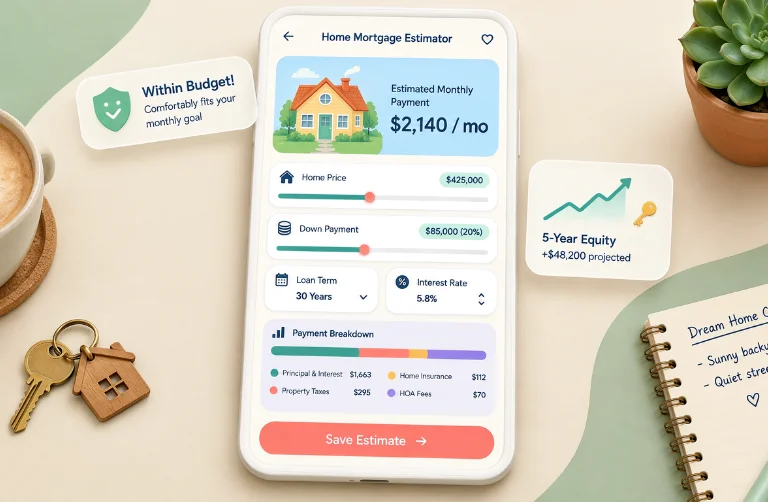
A home mortgage estimator helps you test whether a home fits your monthly budget before applying for financing. A useful estimate includes more than the loan’s principal and interest. It should also account for property taxes, homeowners insurance, mortgage insurance, and applicable association fees.
Direct answer: A reliable mortgage estimate starts with the home price, down payment, loan term, and interest rate. Then add property taxes, homeowners insurance, PMI when required, and any HOA fees. The result gives you a more realistic monthly housing cost than principal and interest alone.
| Input | What it affects | What to enter |
|---|---|---|
| Home price | Purchase amount | Expected purchase price |
| Down payment | Loan size and possible PMI | Cash amount or percentage |
| Interest rate | Monthly principal and interest | Estimated lender rate |
| Loan term | Payment size and repayment period | Commonly 15 or 30 years |
| Property taxes | Monthly housing cost | Local annual tax estimate |
| Homeowners insurance | Monthly housing cost | Annual premium estimate |
| Mortgage insurance | Cost with some lower down payments | Lender or calculator estimate |
| HOA dues | Total housing budget | Monthly association fee |
Key Takeaways
- Your loan payment and your total housing payment are different numbers.
- Taxes, insurance, PMI, and HOA fees can materially raise monthly costs.
- Interest rates should be tested across several scenarios.
- A larger down payment lowers the financed balance but uses more cash upfront.
- Estimates are planning tools, not lender approvals or official Loan Estimates.
- Closing costs should be considered separately from the recurring monthly payment.
How a Home Mortgage Estimator Calculates Your Payment

The Home Mortgage Estimator basic mortgage calculation uses your loan amount, interest rate, and repayment term. Your loan amount equals the purchase price minus your down payment. A fixed-rate loan then spreads principal and interest across the selected repayment period.
That calculation only produces principal and interest, often called P&I. The Consumer Financial Protection Bureau says a total monthly payment can also include mortgage insurance, taxes, and homeowners insurance. HOA or condominium fees may be separate expenses as well.
This distinction matters when you compare homes near the top of your budget. Two properties with the same purchase price can have different taxes, insurance premiums, or association costs. Your true monthly obligation can therefore differ even when the loan amounts match.
Readers researching broader property topics can also browse NewPapero’s Real Estate section. It provides a natural starting point for related housing and ownership content. NewPapero also maintains a separate Home Improvement section for ownership-related projects.
What Costs Should You Include?
A useful estimate starts with principal and interest but should not stop there. Property taxes and homeowners insurance commonly appear in the borrower’s total housing payment. The lender may collect those amounts through an escrow account.
Private mortgage insurance can also apply to some conventional mortgages with smaller down payments. The Consumer Financial Protection Bureau notes that mortgage insurance is typically required when the down payment is below 20 percent. Exact requirements and cancellation rules depend on the loan and lender.
Association dues deserve separate attention because many calculators omit them. Condo and homeowners association charges can add hundreds of dollars to monthly housing costs. Treat those charges as part of affordability even when your lender collects them separately.
A 2026 Mortgage Payment Example
Consider a $400,000 home with a 20 percent down payment. That leaves a $320,000 loan before financing fees or other adjustments. Suppose you test a 30-year fixed rate of 7.32 percent.
Freddie Mac reported an average 30-year fixed mortgage rate of 7.32 percent on October 22, 2026. Its reported 15-year average was 6.68 percent. These averages are market benchmarks, not guaranteed rates for individual borrowers.
At 7.32 percent, the estimated principal-and-interest payment on $320,000 is about $2,200 monthly. Add $400 for estimated property taxes and $180 for homeowners insurance. The illustrative total becomes roughly $2,780 before HOA dues or other property-specific costs.
That example shows why the headline loan payment can be misleading. A buyer who budgets only $2,200 would overlook several hundred dollars in recurring expenses. Your local figures may also differ significantly from this illustration.
How Interest Rates Change Affordability
Interest rates can change what you can comfortably borrow without changing the home price. A higher rate sends more of each payment toward borrowing costs. A lower rate can reduce monthly principal and interest for the same loan balance.
Rates can also change quickly, so test several possible scenarios. Try the rate you expect, then calculate payments at rates 0.5 and 1 percentage point higher. This simple stress test shows whether your budget still works if financing becomes more expensive.
Do not assume the national weekly average will become your personal offer. Lenders consider factors such as credit profile, loan type, down payment, property use, and market conditions. Comparing official Loan Estimates remains more reliable than comparing advertised rates alone.
How Your Down Payment Changes the Estimate
A larger down payment reduces the amount you need to finance. That usually lowers the monthly principal-and-interest payment. It may also reduce or eliminate mortgage insurance on certain conventional loans.
Still, putting every available dollar into the down payment can create another problem. Homeowners need cash for closing, moving, maintenance, repairs, and emergencies. A lower payment has limited value if the purchase leaves you without adequate reserves.
Test several down-payment amounts instead of assuming the largest one is automatically better. Compare 5, 10, 15, and 20 percent when those scenarios fit your loan options. Then review the monthly payment and remaining cash together.
Do Not Forget Closing Costs
Monthly affordability is only part of the buying decision. Mortgage transactions can include lender charges, appraisal costs, title services, government fees, prepaid expenses, and escrow deposits. The exact combination varies by transaction and location.
Your lender’s Loan Estimate provides a much stronger picture once you formally apply. The CFPB recommends reviewing total loan costs, lender credits, monthly payments, and estimated cash to close. Those figures let you compare offers using the same categories.
Keep cash-to-close planning separate from your recurring monthly estimate. A home can fit your monthly budget while still requiring more upfront cash than expected. Both numbers need to work before you proceed.
Estimate What You Can Afford Before Shopping
Start with the maximum monthly housing payment that fits your budget. Subtract expected property taxes and insurance from that amount. The remaining figure shows how much room you have for principal and interest.
The CFPB recommends a similar approach when estimating an affordable loan amount. Buyers can adjust the loan balance until the calculator produces a suitable principal-and-interest payment. Adding the planned down payment then gives an approximate affordable purchase price.
Avoid treating the maximum amount a lender may approve as your required spending target. Your personal budget also includes transportation, childcare, debt payments, savings, and other goals. A comfortable payment may be lower than the maximum qualification amount.
Common Mortgage Estimation Mistakes
The most common mistake is entering only the price, rate, and term. That calculation ignores several costs that affect monthly affordability. Taxes and insurance can change substantially between neighborhoods and properties.
Another mistake is using an unrealistically low interest rate. A lower rate makes the projected payment look easier to handle. Test a conservative scenario so a small market move does not break your budget.
Buyers also sometimes forget that escrow costs can change over time. Property taxes and insurance premiums can rise after the purchase. A fixed-rate mortgage keeps the interest rate fixed, but it does not freeze every housing expense.
Property decisions can become more complicated when several people share ownership. NewPapero’s guide on co-owner property disputes explains issues that can arise when owners disagree about selling. That topic becomes especially relevant when a jointly owned property still carries a mortgage.
Use the Estimate as a Planning Tool
A good mortgage estimate helps you compare homes before emotions or negotiations take over. Run several combinations of price, down payment, rate, and taxes. Keep the scenario that leaves enough room for savings and normal monthly expenses.
Once you find a workable range, request quotes from multiple lenders and compare their Loan Estimates. Focus on the total monthly payment, upfront costs, interest rate, and cash to close. An estimator starts the decision, while verified lender figures should finish it.
Home Mortgage Estimator FAQ
How accurate is a home mortgage estimator?
A home mortgage estimator can provide a strong planning estimate when its inputs are realistic. It cannot predict your final approved interest rate, insurance premium, taxes, or lender fees. Use your lender’s official disclosures before making a final financial decision.
Does a mortgage calculator include property taxes?
Some calculators include taxes automatically, while others require you to enter them. Check the results before assuming the displayed payment is complete. A principal-and-interest figure alone is not your full monthly housing expense.
What happens if I put less than 20 percent down?
A smaller down payment increases the amount you borrow. Some conventional borrowers may also need private mortgage insurance. Other mortgage programs use different insurance or fee structures.
Should I use today’s mortgage rate in my estimate?
Use a current market rate as a starting point, then test higher scenarios. Your actual rate depends on your borrower profile and chosen loan. Market averages should therefore be treated as reference points rather than promises.
How much house can I afford?
Start with a monthly payment that works alongside your other expenses and savings goals. Include taxes, insurance, possible mortgage insurance, and HOA dues before choosing a price range. Then compare your estimate with actual lender offers.