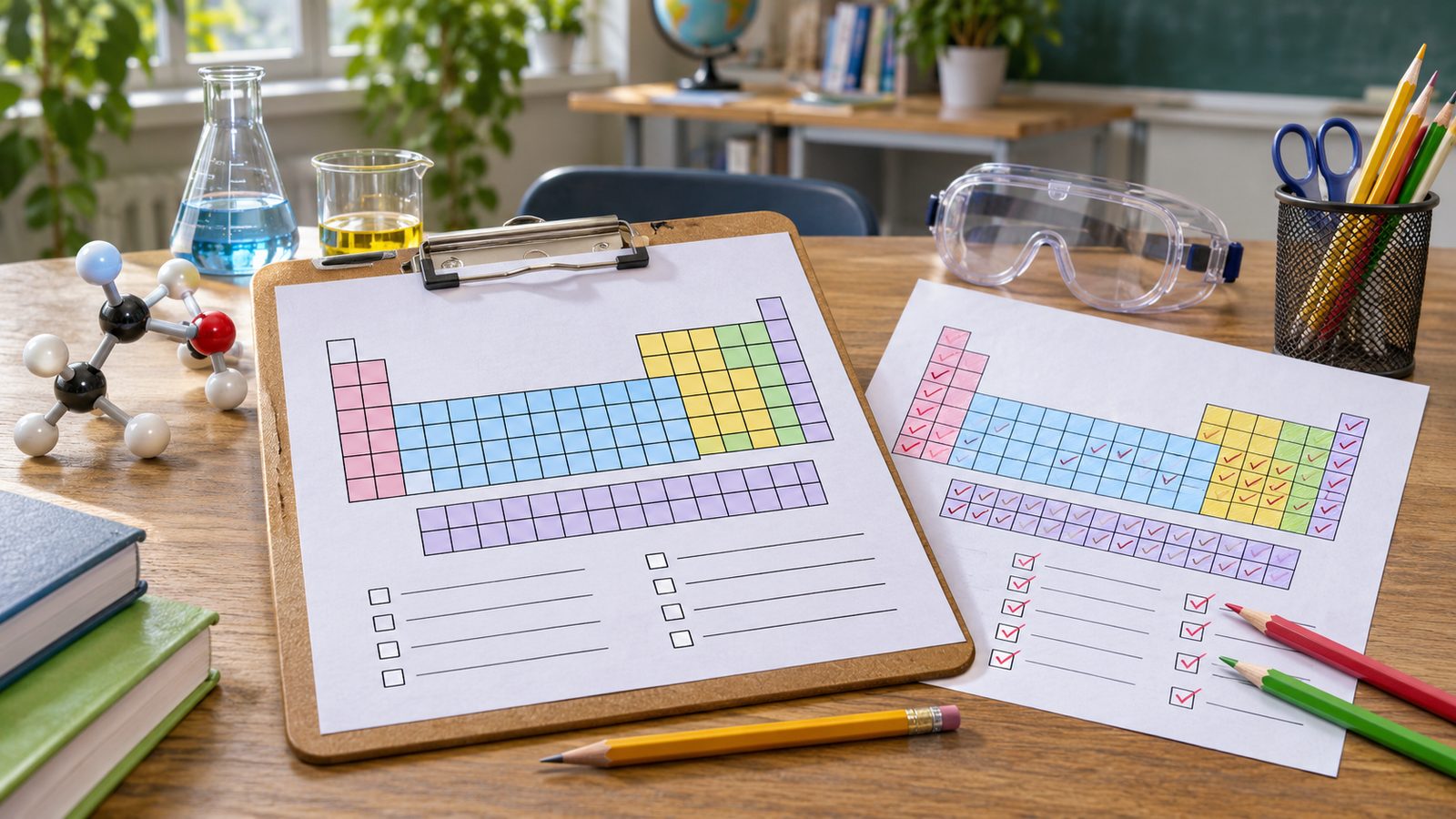
A good periodic table worksheet should test more than memorized element names. It should help students read the table and connect its different pieces of information. This teacher-ready resource includes 25 original questions, a full answer key, differentiation ideas, and simple PDF-saving directions. Quick answer: This worksheet covers element symbols, atomic numbers, atomic masses, groups, periods, metals, nonmetals, and valence electrons. It works well for introductory U.S. middle school or high school chemistry. Teachers can copy the worksheet into a document, adjust spacing, and save the finished page as a PDF.
| Worksheet feature | Details |
|---|---|
| Questions | 25 |
| Main topics | Symbols, atomic number, atomic mass, groups, periods, element types, valence electrons |
| Answer key | Included below |
| Suggested audience | Introductory middle school or high school chemistry |
| Current element count | 118 recognized elements |
| Group numbering | IUPAC Groups 1–18 |
| Periods | Seven rows |
| Printing | Works well on U.S. Letter paper |
| PDF option | Copy to a document and choose Print or Save as PDF |
The modern table contains 118 recognized elements. IUPAC recommends numbering its vertical groups from 1 through 18. The seventh period became complete after recognition of elements through atomic number 118. Teachers who want other learning-focused material can also browse NewPapero’s Education section. A separate NewPapero guide on three-digit addition with regrouping shows the site’s step-by-step classroom style.
How to Use This Periodic Table Worksheet
This periodic table worksheet can work as guided practice, independent work, homework, or a short assessment. Give students access to a classroom element chart unless you want symbol recall assessed from memory. You can also assign individual sections after teaching each skill. The worksheet moves from straightforward identification toward relationships within the table. Early questions focus on symbols and numbers. Later questions ask students to interpret groups, periods, classifications, and outer-shell electrons. For atomic-weight questions, this resource uses current abridged standard atomic weights from CIAAW. Classroom charts often label this value “atomic mass,” although standard atomic weight is the more precise term. CIAAW’s current abridged table includes updated recommended values based mainly on its 2021 report, with several 2024 revisions.
Printable Periodic Table Worksheet
Name: ____________________ Date: ____________________ Class/Period: ____________________
Part A: Element Symbols
- Write the chemical symbol for hydrogen: ____________
- Write the chemical symbol for sodium: ____________
- Write the chemical symbol for iron: ____________
- Write the element name represented by O: ____________
- Write the element name represented by Cu: ____________
Part B: Atomic Number and Atomic Mass
- What is the atomic number of carbon? ____________
- What is the atomic number of chlorine? ____________
- Using the periodic table, write carbon’s abridged standard atomic weight: ____________
- Using the periodic table, write iron’s abridged standard atomic weight: ____________
- Using the periodic table, write copper’s abridged standard atomic weight: ____________
Part C: Groups and Periods
- Are groups arranged vertically or horizontally? ____________
- Are periods arranged vertically or horizontally? ____________
- How many numbered groups are used in the modern IUPAC system? ____________
- How many periods are in the modern periodic table? ____________
- Sodium is in Group 1 and Period 3. Which number identifies its row? ____________
Part D: Metals and Nonmetals
- Is sodium classified as a metal or nonmetal? ____________
- Is oxygen classified as a metal or nonmetal? ____________
- Is iron classified as a metal or nonmetal? ____________
- Is chlorine classified as a metal or nonmetal? ____________
- Most elements on the left side and center of the table are generally ____________.
Part E: Valence Electrons
Use main-group patterns for Questions 21–25.
- How many valence electrons does sodium have? ____________
- How many valence electrons does magnesium have? ____________
- How many valence electrons does aluminum have? ____________
- How many valence electrons does carbon have? ____________
- How many valence electrons does chlorine have? ____________
Periodic Table Worksheet Answer Key
The answer key uses standard symbols, atomic numbers, and current abridged atomic-weight values. CIAAW lists carbon as 12.011, iron as 55.845, and copper as 63.546. Those values are suitable for the questions above.
Part A Answers
- H
- Na
- Fe
- Oxygen
- Copper
Part B Answers
- 6
- 17
- 12.011
- 55.845
- 63.546
Part C Answers
- Vertically
- Horizontally
- 18 groups
- 7 periods
- 3
Part D Answers
- Metal
- Nonmetal
- Metal
- Nonmetal
- Metals
Part E Answers
- 1 valence electron
- 2 valence electrons
- 3 valence electrons
- 4 valence electrons
- 7 valence electrons
What Students Should Know Before Starting
Students should understand that atomic number identifies the number of protons in an element’s nucleus. Each element has a unique atomic number. Changing the proton count changes the identity of the element. Students should also recognize the difference between groups and periods. Groups run down the table, while periods run across it. Elements in the same main group often share useful chemical patterns. Atomic-weight notation may require a short teacher explanation. Several elements have standard atomic weights represented by intervals because natural isotope proportions can vary. An abridged classroom value gives students a practical number while preserving appropriate scientific accuracy.
Teaching Groups, Periods, and Valence Electrons
Group numbering gives students a consistent way to discuss vertical columns. IUPAC has recommended the 1–18 numbering system since 1988. This avoids older systems that used different letter-and-number labels. For introductory main-group chemistry, group position can help students predict valence electrons. Group 1 elements have one outer-shell electron, while Group 2 elements have two. Groups 13 through 18 usually correspond to three through eight outer-shell electrons for main-group elements. Helium is an important exception to the simple eight-electron pattern. Its first electron shell holds only two electrons. Teachers may want to discuss helium separately before assigning noble-gas valence questions. Transition metals need more advanced treatment than the simple main-group rule. Their electron configurations make quick group-number shortcuts less reliable. That is why the printable practice above uses familiar main-group elements for valence-electron questions.
Differentiation Tips for Different Learners
Students who need extra support can complete one section at a time. Provide a color-coded reference table and highlight group numbers before they begin. You can also model one example from each section. For developing learners, reduce the memory demand without removing the chemistry skill. Let students use a full reference table for symbols and atomic data. Ask them to explain how they located each answer afterward. Students who are ready for more challenge can justify their answers in complete sentences. They can also identify element families, compare reactivity, or predict common ion charges. Adding electron configurations creates another useful extension. English learners may benefit from a small vocabulary box. Include the terms element, symbol, atomic number, group, period, metal, nonmetal, and valence electron. Pair each term with a simple diagram or location clue. Teachers can also divide the periodic table worksheet into an entry task and exit ticket. Use Parts A and B before instruction to check prior knowledge. Use Parts C through E afterward to measure conceptual understanding.

Easy Ways to Use the Worksheet in Class
For a quick warm-up, assign five questions and review them aloud. Students can compare answers with a partner before whole-class feedback. This approach gives you fast information about common misconceptions. For independent practice, assign all five sections after a short review lesson. Ask students to circle any question that required checking their reference table. Those marks can show which skills still need support. For assessment, remove the reference chart if symbol recall is part of your goal. Keep one available when the goal is reading and interpreting element information. The reference policy should match the skill you intend to measure.
How to Save the Worksheet as a PDF
You do not need a special worksheet file to create a printable PDF. Copy the worksheet section and answer key into Google Docs, Microsoft Word, or another document editor. Adjust page breaks so the student sheet ends before the answer key. Next, choose U.S. Letter paper if you teach in the United States. Use standard margins and a readable classroom font. Check the print preview before creating the final file. In Google Docs, open File > Download > PDF Document (.pdf). Most browsers and desktop programs also provide Print > Save as PDF. Save the student worksheet and answer key separately when you do not want students seeing the answers.
Accuracy Notes for Teachers
NIST maintains a printable element table containing critically evaluated atomic-property data. IUPAC also publishes an authoritative table for chemistry education. These references are useful when checking classroom materials or replacing outdated charts. The current CIAAW abridged values include 35.45 for chlorine, 39.098 for potassium, and 40.078 for calcium. Sodium is listed as 22.990, while magnesium is 24.305. Values on older classroom charts may differ slightly because recommendations and rounding practices can change. Teachers should avoid treating rounded atomic weight as a proton or neutron count. Atomic number gives the proton count. Standard atomic weight reflects isotope-weighted information and is usually not a whole number.
Frequently Asked Questions
What grade level is a periodic table worksheet best for?
A periodic table worksheet can fit several grade levels because question difficulty can change. This version suits introductory physical science or chemistry classes. Teachers can simplify the atomic-weight section or extend the electron questions as needed.
How many elements are on the modern periodic table?
There are 118 recognized elements in the modern table. Element 118 is oganesson, with the symbol Og. Recognition of elements 113, 115, 117, and 118 completed the seventh period.
What is the difference between a group and a period?
A group is a vertical column, while a period is a horizontal row. The standard IUPAC numbering system contains 18 groups. The table contains seven periods.
Is atomic mass the same as atomic number?
No, the two values describe different information. Atomic number equals the number of protons in an atom’s nucleus. Classroom “atomic mass” usually refers to the element’s listed standard atomic weight.
Why do some atomic weights contain decimals?
Most elements occur naturally as mixtures of isotopes. Their listed standard atomic weights reflect isotope masses and natural abundance information. That process commonly produces a decimal value rather than a whole number.
A Practical Next Step for Teachers
Print the student section first and keep the answer key on a separate page. Choose whether students may use a reference table based on your learning objective. Then adjust the differentiation level before assigning the activity. This format gives students practice with several connected skills instead of isolated recall. It also provides teachers with one resource that can support instruction, practice, or assessment. For more classroom-focused material, browse NewPapero’s education resources. —