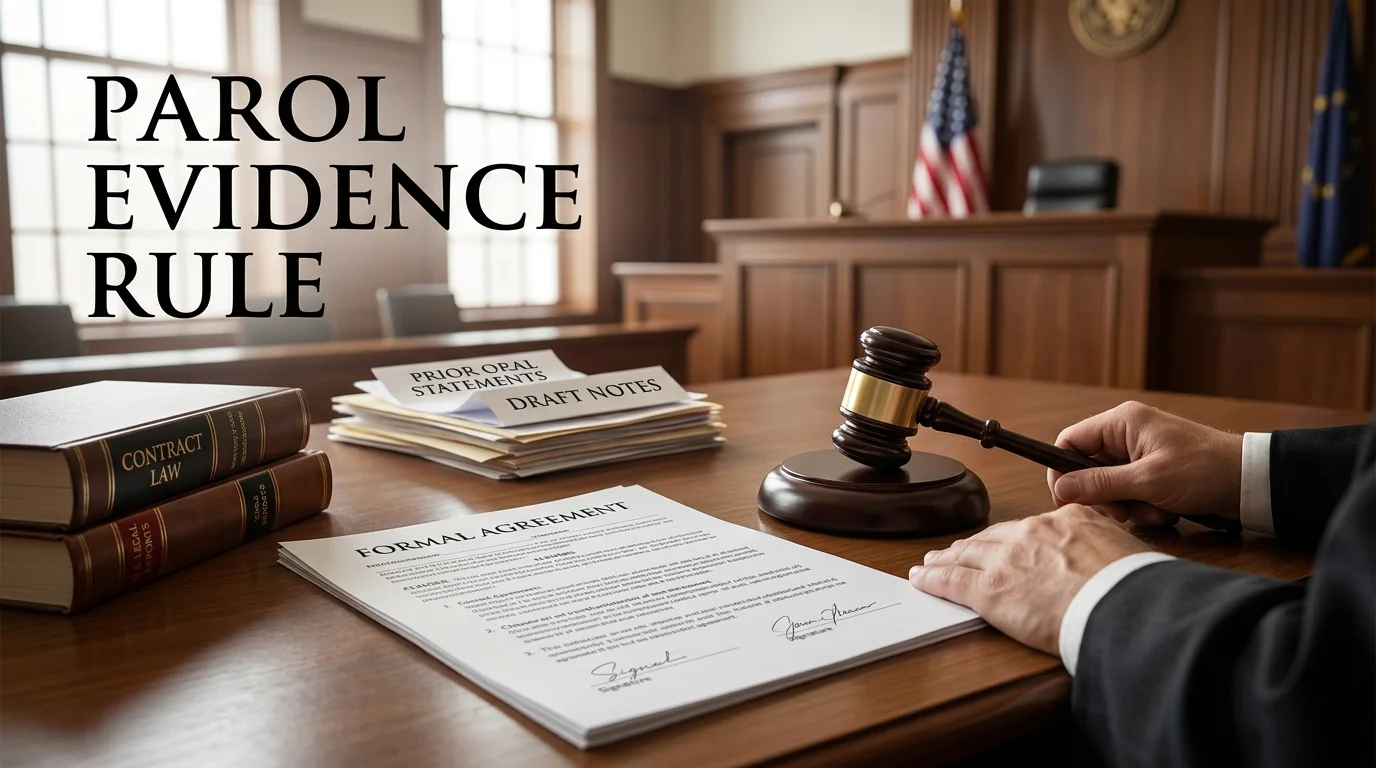
The parol evidence rule limits when a party can use statements, promises, negotiations, or other material outside a written contract to change its terms. In general, an earlier or contemporaneous agreement cannot contradict a final written agreement that the parties intended to control their deal. The details matter because courts first consider whether the writing is complete, partial, ambiguous, or subject to an exception.
Direct answer: Under U.S. contract law, courts generally exclude earlier or contemporaneous outside agreements that contradict a final written contract. The key question is whether the writing is integrated. Courts may still admit outside evidence for recognized purposes, including ambiguity, fraud, mistake, a valid collateral agreement, or a later modification.
This doctrine can affect business agreements, sales contracts, leases, employment agreements, and other written deals. Its application can also vary by state, so the governing jurisdiction matters in a real dispute. This article provides general educational information, not legal advice.
Key Facts at a Glance
| Issue | Plain-English explanation |
|---|---|
| Main purpose | Protects a final written contract from being contradicted by earlier or simultaneous outside agreements |
| Evidence involved | Oral statements, emails, drafts, letters, negotiations, and other extrinsic material |
| Central question | Did the parties intend the writing to be a final expression of their agreement? |
| Complete integration | Usually blocks contradictory and consistent additional terms within the agreement’s scope |
| Partial integration | May allow consistent additional terms but generally not contradictory ones |
| Common exceptions | Ambiguity, fraud, mistake, collateral agreements, conditions, and later modifications |
| Sale of goods | UCC § 2-202 supplies an important rule for contracts governed by Article 2 |
| Merger clause | Strong evidence that the writing was intended as the complete agreement |
Key takeaways: A court does not automatically ignore everything outside a written contract. It first asks whether the document is integrated and how complete that integration is. The purpose for which outside evidence is offered also matters, because evidence used to interpret or challenge a contract may receive different treatment from evidence offered to contradict it.
What the Rule Means in Contract Law
Despite the word “parol,” the doctrine is not limited to spoken statements. It can cover prior written communications, emails, draft agreements, letters, and negotiations that sit outside the final contract. Cornell’s Legal Information Institute entry on parol evidence states that a completely integrated written agreement generally cannot be contradicted by prior or contemporaneous agreements, and it points to UCC § 2-202 as the parallel rule for sales of goods.
The idea is easier to understand with a simple example. Suppose a signed contract says a buyer will pay $20,000, but the buyer claims the seller previously promised $15,000. If the written agreement is final and complete, a court may refuse to use that earlier promise to contradict the stated price.
Readers learning legal terminology can find related explanations in Newpaper’s Law section. Its legal articles focus on putting technical concepts into plain English. That approach is useful because contract disputes often turn on the precise meaning of familiar-looking words.
When the Parol Evidence Rule Applies
The doctrine normally becomes relevant when parties reduce their deal to a written agreement meant to be final. The disputed evidence must usually concern negotiations or agreements made before the writing, or at roughly the same time. Courts treat statements and conduct after the contract differently because they may concern modification, waiver, or later performance.
Courts also ask why a party wants to admit outside evidence. Trying to replace a written price with an earlier oral price presents a classic problem. Using surrounding facts to identify an ambiguous subject, prove fraud, or show a later modification raises a different issue.
This distinction between legal issues can be easier to follow once you understand which court and body of law governs the dispute. Newpapero’s jurisdiction definition explainer covers subject-matter, personal, and territorial authority in plain language. Those concepts become significant when state rules differ.
Complete Integration vs. Partial Integration
An integrated agreement is a writing intended to represent the parties’ final agreement on at least some terms. A completely integrated contract is intended as the complete and exclusive statement of the deal. A partially integrated contract is final as to the terms it contains, but it may not contain every agreed term.
| Type of writing | Contradictory prior terms | Consistent additional terms |
|---|---|---|
| Completely integrated | Generally excluded | Generally excluded within the agreement’s scope |
| Partially integrated | Generally excluded | May be admitted in appropriate circumstances |
| Not integrated | The doctrine may not control | Other contract and evidence rules may still apply |
Consider a written agreement that settles price, quantity, delivery date, warranties, and remedies in detailed language. That document is more likely to look complete than a short memorandum addressing only price and quantity. Courts apply governing state law when deciding how much weight to give completeness, surrounding circumstances, and contract language.
Major Exceptions and Situations Where Outside Evidence May Be Considered
The exclusion rule is significant, but it is not absolute. Courts may consider external material when it is offered for a legally recognized purpose rather than to rewrite an integrated agreement. Thomson Reuters identifies several recurring situations in which outside material can become relevant.
- Ambiguity: Evidence may help explain contract language reasonably capable of more than one meaning.
- Fraud or duress: Outside communications may help show that the agreement was induced through wrongful conduct.
- Mistake: Drafts or negotiations may help establish a clerical or mutual mistake in an appropriate case.
- Condition precedent: Evidence may help prove that performance depended on an agreed event occurring first.
- Collateral agreement: A separate, consistent side agreement may sometimes fall outside the writing’s scope.
- Identification: External facts can help identify a person, object, property, or subject mentioned in the agreement.
- Trade usage or prior dealings: Commercial context may explain how parties understood particular terms.
- Later modification: Conduct or agreements formed after execution generally raise a later-modification question instead.
The availability and scope of these exceptions can depend on the jurisdiction and the type of contract. A court may also distinguish between evidence offered to interpret a term and evidence offered to contradict it. That distinction is one reason legal analysis should focus on the evidence’s proposed use, not merely whether the information exists outside the contract.
Legal terminology often turns on similarly fine distinctions. Newspaper’s inchoate meaning and legal-use guide offers another example of how a familiar concept can gain a narrower meaning in law. Reading legal words in context helps prevent broad definitions from being applied too mechanically.
How UCC Section 2-202 Changes the Analysis for Sales of Goods

Article 2 of the Uniform Commercial Code addresses sales of goods, and § 2-202 contains its version of the rule concerning final written expressions. It provides that final written terms cannot be contradicted by prior agreements or contemporaneous oral agreements. The writing may still be explained or supplemented in circumstances recognized by the section.
The statute specifically refers to course of dealing, usage of trade, and course of performance. It also permits consistent additional terms unless the writing was intended as a complete and exclusive statement. Check the version enacted in the governing state because the UCC operates through state adoption.
That means a commercial dispute over goods may require a slightly different analysis from a common-law service contract. A court may examine industry practice and the parties’ established dealings when Article 2 permits that context. The type of transaction should therefore be identified early. More from us: Malfeasance Definition.
What Does a Merger or Integration Clause Do?
A merger clause, also called an integration clause, usually states that the written contract represents the parties’ complete agreement. It may also say that earlier discussions, promises, or representations have been superseded. Such language gives a court strong evidence that the parties intended the document to be complete.
A merger clause does not mean that every outside fact becomes legally irrelevant in every dispute. Claims involving fraud, mistake, ambiguity, later modification, or other recognized grounds can raise separate questions. The effect of the clause should therefore be assessed under the law governing the particular contract.
For parties drafting agreements, the practical lesson is straightforward. Important promises should appear clearly in the signed document rather than being left in emails or conversations. A complete written record reduces later arguments about what someone remembers being promised.
A Four-Part Way to Analyze a Contract Dispute
A useful analysis starts by breaking the dispute into four questions. This method prevents the broad phrase “outside evidence” from ending the inquiry. Each stage narrows what the court must decide.
| Question | What to examine |
|---|---|
| Is there a final writing? | Determine whether the document was intended as a final expression of agreed terms |
| How integrated is it? | Decide whether it is complete, partial, or not integrated |
| What does the proposed evidence do? | Ask whether it contradicts, supplements, explains, identifies, or challenges the agreement |
| Is there an exception or separate doctrine? | Consider fraud, mistake, ambiguity, later modification, trade usage, or other applicable rules |
This framework is especially useful for students because it turns an abstract doctrine into a sequence of concrete questions. It can also help business owners recognize why keeping contract drafts and communications may still matter. Whether those materials become admissible is a legal question for the governing court.
Practical Example: An Earlier Promise and a Written Contract
Imagine a landlord and commercial tenant negotiate several improvements before signing a detailed lease. During negotiations, the landlord says the building will receive a new parking area, but the signed lease says nothing about that work. The lease also contains a clause stating that it is the parties’ complete agreement.
If the tenant later tries to enforce the earlier promise, the court would examine the integration clause, the lease’s completeness, and the governing state’s rules. It would also ask whether the alleged promise contradicts the written agreement or qualifies as a separate collateral undertaking. The answer cannot be determined from the existence of the oral statement alone.
Property disputes remind us that written agreements and governing state law often interact. Newpapero’s guide to a co-owner refusing to sell shared property discusses a different property problem in which documentation and jurisdiction also matter. Contract disputes require the same care with facts and controlling law.
Why State Law Matters
Contract law in the United States is largely shaped by state law, while the UCC supplies widely adopted rules for sales of goods. Courts can differ in how they decide whether an agreement is integrated and when extrinsic material may be considered. A rule stated broadly in a textbook may therefore produce different results when applied under two states’ precedents.
This point matters most in an active lawsuit or high-value contract dispute. The contract may contain a choice-of-law clause, and procedural questions can also affect the case. A licensed attorney can identify the controlling statutes and appellate decisions for the relevant jurisdiction.
Frequently Asked Questions
What is the parol evidence rule in simple terms?
It generally prevents a party from using earlier or contemporaneous outside agreements to contradict a final written contract. The court first considers whether the writing was intended to be final and how complete it is. Recognized exceptions and other contract doctrines may still make outside evidence relevant.
Does the rule apply only to oral statements?
No. The term can include written material outside the final contract, such as emails, letters, drafts, and earlier written agreements. What matters is the timing, purpose, and relationship between that evidence and the final writing.
Can evidence from after the contract was signed be used?
The doctrine primarily concerns prior and contemporaneous agreements. A later agreement or later conduct may instead raise questions about modification, waiver, or performance. Other legal requirements can still determine whether that later evidence has effect.
Does a merger clause always prevent outside evidence?
No single clause automatically answers every possible dispute. A merger clause is strong evidence that the parties intended a complete written agreement, but issues such as fraud, mistake, ambiguity, or later conduct may require separate analysis. State law determines the clause’s legal effect in a specific case.
How does UCC 2-202 relate to the rule?
UCC § 2-202 addresses final written expressions in transactions governed by Article 2, which concerns sales of goods. It prevents contradiction of final written terms while allowing specified forms of explanation or supplementation. The enacted law of the governing state should be checked before applying the provision.
The Practical Takeaway
Written contracts receive substantial weight because they provide a durable record of what parties agreed. Still, courts do not decide every dispute by mechanically ignoring everything beyond the document’s four corners. Integration, the purpose of the proposed evidence, statutory rules, exceptions, and state law all shape the analysis.
If you are studying contract law, start by identifying the final writing and deciding whether it appears complete or partial. Then ask exactly what the outside evidence is supposed to prove before considering an exception.